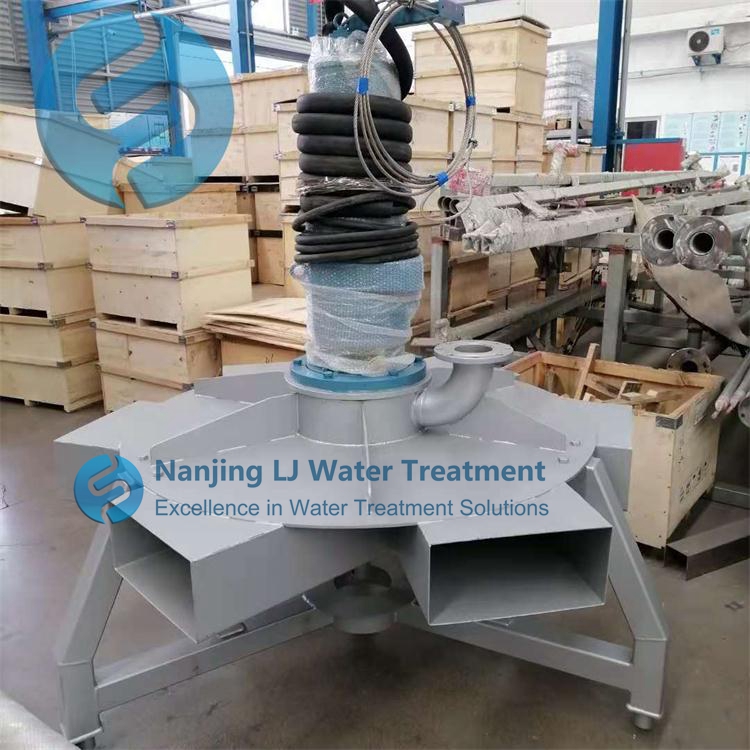
Aeration mixers play a critical role in ensuring uniform oxygen distribution and thorough water circulation across different water body sizes, and their span adaptation parameters directly determine the operational stability and treatment efficiency in various water environments.
Core Span Adaptation Principles
Hydraulic Resistance Matching for Different Water Widths
When designing aeration mixer span parameters, the first key factor is to align the equipment’s thrust output with the natural hydraulic resistance of the target water area. For narrow water zones under 5 meters in width, the flow diffusion range of the mixer should be controlled to avoid excessive disturbance that causes sediment resuspension at the bottom. For medium-width water areas between 5 and 20 meters, the thrust gradient needs to be adjusted to form a continuous circulating flow belt that covers the full cross-section without leaving dead zones. For wide water bodies over 20 meters, the flow superposition effect between multiple mixer units must be calculated carefully to ensure no gaps in the mixing coverage across the entire span.
Flow Velocity Consistency Requirements Along the Span
The flow velocity generated by aeration mixers should maintain a stable gradient along the full water span, with no sudden changes that break the continuity of water movement. The minimum flow velocity at the farthest point from the mixer installation position should stay above 0.1 meters per second to prevent suspended solids from settling in low-flow areas. The maximum flow velocity near the mixer outlet should not exceed 1.5 meters per second to avoid damaging the natural structure of the water body’s bottom sediment and disrupting the growth environment of native aquatic organisms. This consistent velocity distribution helps maintain a balanced oxygen transfer rate at every point across the entire water span.
Key Parameter Reference Ranges
Immersion Depth Adjustment for Different Water Depths
The immersion depth of the aeration mixer’s working component is a core parameter linked to water span adaptation, as it directly affects the vertical diffusion height of the aerated flow. In shallow water areas with a depth less than 2 meters, the immersion depth should be set between 0.3 and 0.6 meters to push the aerated flow to spread horizontally along the water surface, expanding the effective mixing span as much as possible. In water areas with a depth between 2 and 5 meters, the immersion depth can be adjusted to 0.8 to 1.5 meters, allowing the aerated flow to form a complete vertical circulation that covers both the upper and lower layers of the water body while extending the horizontal coverage distance. In deep water areas over 5 meters, the immersion depth should be controlled at 2 to 3 meters, ensuring the aerated flow has enough momentum to reach the far end of the water span without losing too much energy during the rising process.
Installation Spacing Between Multiple Units
When multiple aeration mixers are deployed to cover a large water span, the installation spacing between adjacent units must match the effective diffusion radius of each single mixer. For mixers with a low thrust level, the spacing should not exceed 8 meters to ensure the flow fields from two neighboring units can overlap smoothly. For mixers with a medium thrust level, the spacing can be extended to 12 to 18 meters, creating a continuous circulating flow that runs through the entire water span. For high-thrust mixer configurations, the maximum spacing can reach 25 meters, but additional flow field simulation is required to verify that no mixing dead zones exist between the units along the full width of the water area.
Field Calibration Methods for On-site Deployment
Real-time Flow Velocity Testing Along the Cross-section
After the initial installation of aeration mixers, field personnel need to arrange multiple test points evenly along the full span of the target water cross-section to measure the actual flow velocity at different positions. The test points should cover the area near the mixer outlet, the middle position between two adjacent mixers, and the far edge of the water span. By comparing the measured flow velocity data with the pre-design target values, operators can fine-tune the working parameters of each mixer to fill any low-flow gaps that may appear in the initial operation stage. This on-site testing process ensures the span adaptation effect meets the actual hydraulic conditions of the specific water body, rather than only relying on theoretical calculation results.
Oxygen Uniformity Verification Across the Span
Another critical calibration step is to test the dissolved oxygen value at different points along the entire water span after the mixer has run for 2 to 3 hours. The dissolved oxygen difference between the highest point and the lowest point across all test positions should be kept below 0.5 milligrams per liter to confirm that the aeration and mixing effect is evenly distributed over the full water span. If obvious dissolved oxygen differences are found in certain areas, operators can adjust the operating status of corresponding mixer units or slightly modify their installation positions to optimize the flow field distribution. This verification process helps lock in the most suitable span adaptation parameters for the unique characteristics of the local water environment.
Post time:2026-08-10
