Tall and narrow tanks are widely used in wastewater treatment, chemical dosing, and nutrient storage systems.
However, mixing in tall and narrow tanks is more challenging than in shallow tanks, and improper mixer selection can lead to serious process issues.
This article explains the most common mixing problems in tall and narrow tanks and how they affect system performance.
What Is a Tall and Narrow Tank?
In mixing engineering, tank geometry is often described by the height-to-diameter ratio (H/D ratio).
Low H/D ratio → shallow and wide tank
High H/D ratio → tall and narrow tank
When the H/D ratio is greater than about 1.5, the tank is usually considered tall and narrow, and standard mixing configurations may not work effectively.
1. Vertical Stratification (Layering)
The Problem
One of the most common issues in tall tanks is vertical stratification, where the upper and lower liquid layers do not mix properly.
Why It Happens
Single-level impellers generate limited axial flow
Mixing energy is concentrated in the middle or top zone
Bottom regions remain poorly mixed
Impact
Uneven nutrient or chemical concentration
Process instability in downstream biological or flocculation systems
2. Dead Zones Near the Tank Bottom
The Problem
Dead zones are areas with very low flow velocity, often near the tank bottom or corners.
Why It Happens
Impeller coverage does not extend to the full tank height
Insufficient power density at the bottom
Narrow tank diameter restricts flow circulation
Impact
Sedimentation and sludge accumulation
Poor solids suspension
Increased cleaning and maintenance requirements
3. Uneven Mixing Across Tank Height
The Problem
Mixing intensity can vary significantly between the top, middle, and bottom zones.
Why It Happens
Single impeller cannot cover the full liquid depth
Flow loops are confined to local regions
Inadequate vertical circulation patterns
Impact
Inconsistent nutrient distribution
Reduced efficiency in dosing and flocculation processes
4. Instability with Two-Blade Impellers
The Problem
Two-blade impellers are sometimes used for simple mixing tasks, but in tall and narrow tanks they may cause unstable mixing performance.
Why It Happens
Higher torque fluctuation
Less balanced flow pattern
Sensitivity to liquid level changes
Impact
Mechanical stress on shaft and gearbox
Reduced equipment lifetime
Fluctuating mixing performance
5. Overmixing or Undermixing
The Problem
Designers often compensate for poor mixing by increasing motor power, which can cause overmixing in some zones and undermixing in others.
Why It Happens
Power is not distributed uniformly
Incorrect impeller positioning
Lack of multi-level impeller design
Impact
Energy waste
Shear damage to flocs in flocculation tanks
Higher operating costs
How to Avoid These Mixing Problems
For tall and narrow tanks, several design strategies can significantly improve mixing performance:
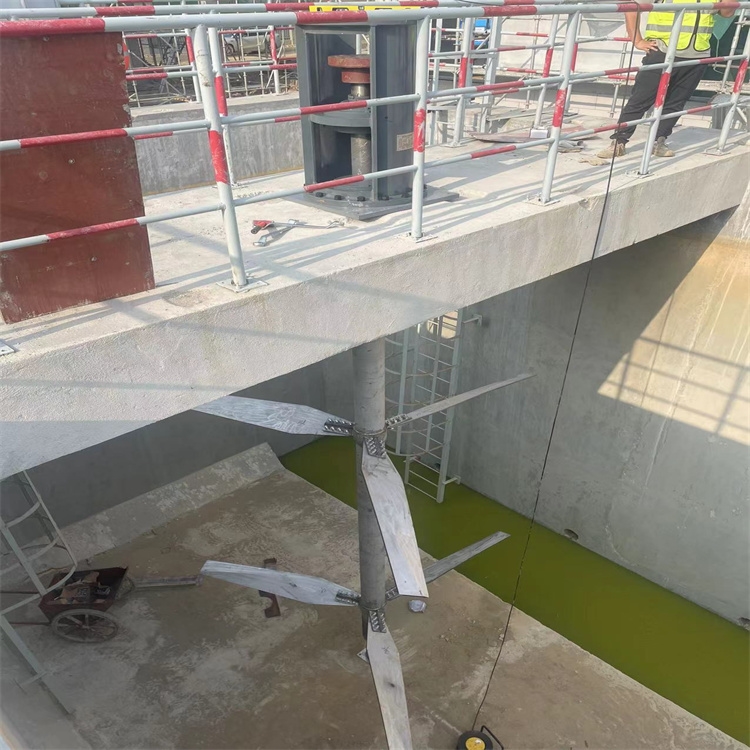
Use multi-level impeller configurations to improve vertical circulation
Select three-blade impellers for more stable flow and torque
Position impellers strategically along the shaft
Consider tank geometry (H/D ratio) during mixer selection, not only diameter
Conclusion
Tall and narrow tanks present unique mixing challenges that cannot be solved by standard mixer configurations.
Understanding vertical stratification, dead zones, and uneven circulation is essential for selecting the right Top Entry Mixer.
A geometry-based mixer design approach can improve process stability, reduce maintenance, and optimize energy consumption.
Post time:2026-01-23
