The process of dissolving atmospheric oxygen into water using an aeration mixer is a fundamental mass transfer operation, governed by physical laws and achieved through specific mechanical design. Its core function is to overcome water's natural resistance to absorbing oxygen, creating the dissolved oxygen (DO) levels necessary for aerobic biological processes and overall water health.
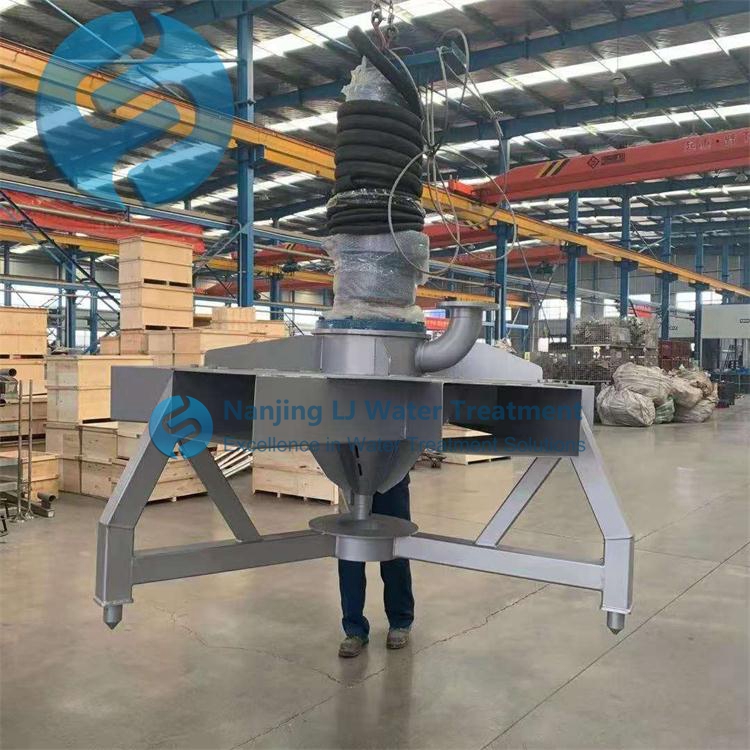
The Dual Mechanism of Oxygen Entrainment and Dispersion
The system initiates oxygen transfer by first creating an interface where air and water meet under turbulent conditions.
A rotating impeller or a pressurized air source generates a region of low pressure, drawing atmospheric air into the water stream. This air is immediately sheared by the mechanical action into a cloud of fine bubbles. The key principle here is that the rate of oxygen transfer is directly proportional to the total surface area of the air-water interface. By creating millions of tiny bubbles, the system maximizes this surface area, providing a vast contact zone for gas exchange. Simultaneously, the mixer's pumping action creates a strong vertical or horizontal water current. This flow serves two purposes: it carries oxygen-depleted water from the bottom and corners of the tank to the bubble-rich zone at the mixer, and it distributes the newly oxygenated water throughout the entire water volume, preventing stratification.
The Molecular Journey from Bubble to Solution
The actual dissolution of oxygen occurs at the microscopic boundary layer surrounding each bubble, driven by a concentration gradient.
Oxygen molecules in the air bubble, at a high partial pressure, diffuse across the gas-liquid interface into the surrounding water, where the dissolved oxygen concentration is lower. This process continues until equilibrium is reached or the bubble dissolves. The turbulence created by the mixer constantly renews the water layer at the bubble's surface, sweeping away oxygen-saturated water and replacing it with oxygen-deficient water. This maintains a steep concentration gradient, which is the driving force for rapid transfer. Smaller bubbles have a higher surface-area-to-volume ratio and a longer rise time, allowing for more contact time and more complete oxygen transfer before they reach the surface. The hydrostatic pressure at depth also increases gas solubility, enhancing the transfer efficiency for bubbles released deeper in the water column.
System Types and Their Distinct Operational Principles
Different mechanical designs achieve this gas-liquid contact through varied primary methods, each suited to specific depth, energy, and application requirements.
Surface Aspiration Aeration relies on a high-speed impeller mounted near the water surface. It draws air down a vortex created by the rotating blades, shearing it into fine bubbles and projecting them radially into the water. This type excels in shallower tanks and applications where oxygen demand is moderate, offering a balance of oxygenation and mixing with mechanical simplicity.
Submerged Diffused Aeration operates by compressing air and forcing it through a submerged diffuser—a membrane, plate, or tube—that creates a curtain of fine to medium bubbles. The primary oxygen transfer occurs as these bubbles rise through the water column. This method is highly efficient for deep tanks, as the increased hydrostatic pressure improves oxygen solubility. It often provides a more uniform horizontal mixing pattern compared to surface units.
Venturi Induction Aeration utilizes the pressure differential created by a constricted water flow. As water is pumped through a narrow venturi section, its velocity increases and pressure drops, sucking air into the stream through an intake port. The turbulent mixture then enters a discharge chamber where the air is sheared into fine bubbles. This design is often valued for its lack of moving parts in the water and effective performance in certain pipeline or channel applications.
Post time:2026-07-09
