Choosing a continuous-operation aeration mixer for long-running water treatment projects requires practical, field-tested judgment that aligns with real-world operating conditions. Many teams focus only on basic aeration capacity while overlooking details that directly affect uptime, energy cost, and long-term service life. The following content breaks down the most critical considerations for selecting a unit that performs reliably under nonstop operating demands.
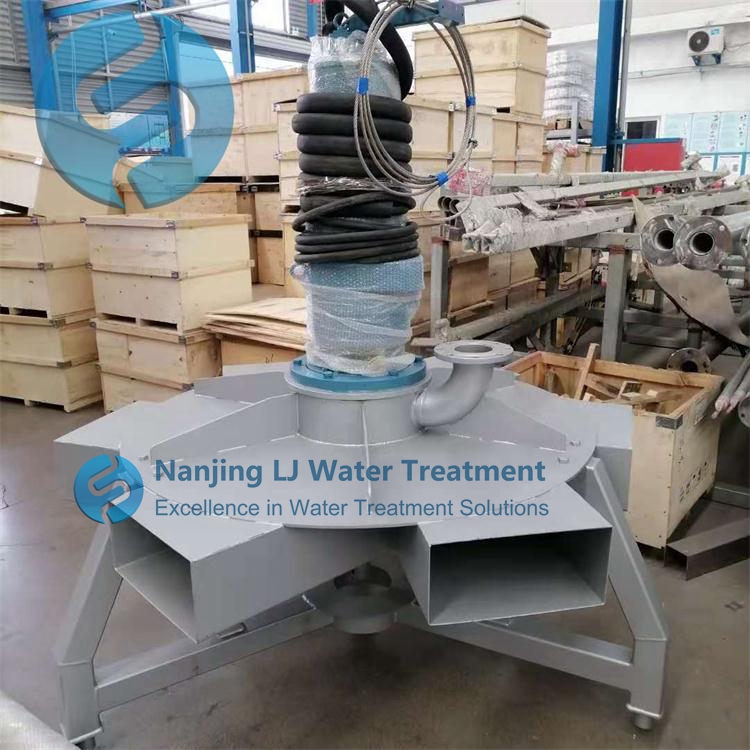
Matching Core Parameters to Actual Water Depth and Tank Geometry
Continuous-operation aeration mixers cannot rely on generic specification sheets that reference standard shallow tank conditions. Every project has unique tank dimensions, sludge deposition patterns, and water flow characteristics that shape how the mixer will perform over thousands of running hours.
You need to confirm that the selected unit delivers sufficient torque output to maintain full flow coverage across the entire tank volume, even under maximum water depth. Insufficient torque will leave dead zones at the tank bottom where sludge accumulates and compacts over time, gradually undermining overall water treatment efficiency.
It is also essential to verify that the aeration structure supports extended bubble residence time in the water column. Units that release bubbles too quickly toward the surface cannot maintain consistent dissolved oxygen distribution across different depth layers, forcing operators to run equipment at higher power just to compensate for uneven oxygen transfer.
Before finalizing any selection, map out the exact flow path the mixer will generate inside the tank. This simple step helps you avoid units that produce strong localized mixing but fail to circulate water evenly through the entire biological treatment zone.
Evaluating Material and Structural Durability for Nonstop Submersed Service
Since continuous-operation aeration mixers remain fully submerged 24 hours a day, every exposed component must withstand prolonged contact with varying water quality conditions without premature degradation. Material choices that work for intermittent duty will often show signs of wear, deformation, or cracking after several months of nonstop operation.
Focus on the abrasion and corrosion resistance of all wetted parts that come into direct contact with mixed water, suspended solids, and potential trace chemical components. Materials that cannot resist long-term fouling or chemical attack will develop surface buildup that disrupts flow patterns and reduces aeration efficiency over time.
Sealing system performance deserves extra attention for units running nonstop at significant water depth. Increased water pressure at depth accelerates seal aging, and even minor seal failure can lead to unexpected motor shutdown that disrupts the entire treatment process. Reliable continuous-operation units incorporate layered sealing designs that maintain protection even after thousands of hours of continuous submersion.
Check the structural consistency of critical mixing components by reviewing manufacturing detail references. Uniform wall thickness, smooth sealing edges, and precisely aligned flow guide surfaces all indicate a design built for extended runtime rather than occasional use.
Ensuring Low-Frequency Maintenance and Operational Adaptability
Many continuous-operation aeration mixer selections fail not because of poor initial performance, but because routine maintenance becomes excessively disruptive once the unit is installed inside an active treatment system. Projects with limited on-site technical support especially benefit from designs that minimize unnecessary intervention.
Prioritize configurations that allow individual component inspection or replacement without requiring full disassembly of the entire air distribution network. This design feature eliminates the need for draining large tank sections or shutting down adjacent treatment lines when performing minor repairs.
Look for units that support adjustable air intake and mixing intensity to adapt to shifting water quality loads throughout different seasons. Continuous water treatment projects often see significant variation in incoming flow volume and organic concentration, and fixed-output units will either waste energy during low-load periods or fail to meet treatment requirements during peak periods.
Confirm that the selected design does not create hidden disassembly points that require specialized tools unavailable to regular on-site operation teams. Simple, accessible connection structures make routine inspection far less time-consuming and reduce the risk of extended unplanned downtime.
Post time:2026-09-28
