The mechanism by which an aeration mixer prevents sludge sedimentation is an active intervention that counters the fundamental forces of gravity and particle cohesion. It goes beyond simple stirring, employing a calculated combination of hydrodynamic lift, particle dispersion, and environmental conditioning to maintain a uniform, pumpable suspension of solids throughout a tank's volume.
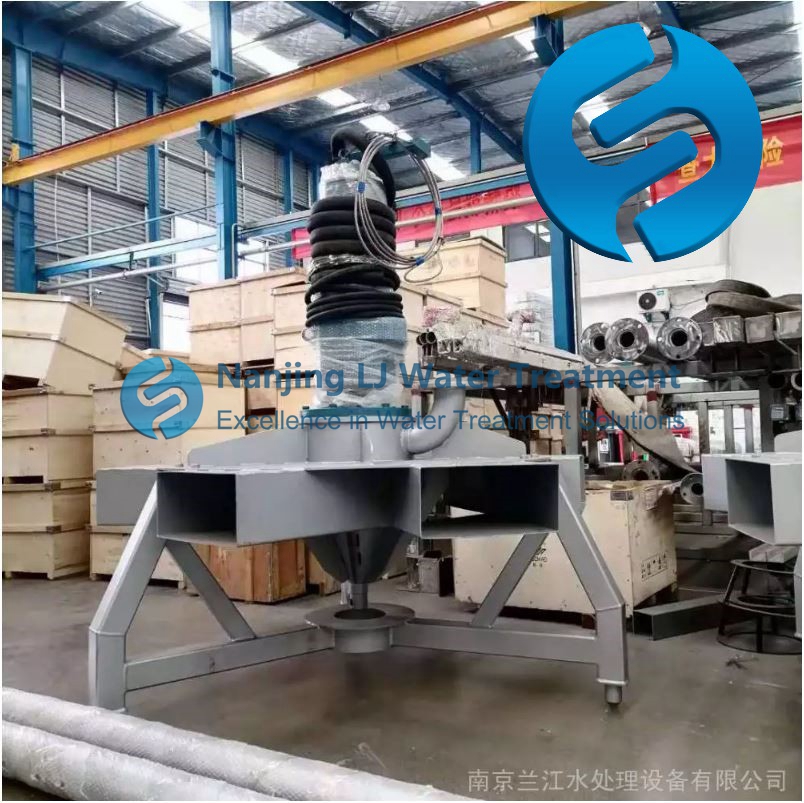
Generating Upward Hydraulic Forces to Counteract Gravity
The primary physical action is the creation of a controlled vertical flow current that imposes an upward force on settling particles, opposing their natural downward trajectory.
The mixer's impeller is designed to move large volumes of water in a specific pattern, often creating a central axial flow that draws fluid from the bottom of the tank upward. This establishes a velocity profile where the upward fluid velocity in the tank's core exceeds the terminal settling velocity of the sludge particles. As particles begin to settle, they are entrained in this upward current and carried back into the main body of the tank. The key is maintaining a minimum upward flow velocity across the entire tank cross-section, particularly in corners and near walls where flow tends to stagnate. This prevents particles from accumulating in "dead zones" where the local flow velocity drops below their settling speed. The entrained air bubbles from the aeration system contribute to this effect by creating additional buoyancy and localized turbulence, further disrupting the laminar flow conditions that favor sedimentation.
Disrupting Floc Network Formation and Cohesive Settling
Sludge particles, especially biological flocs, tend to agglomerate into larger, faster-settling networks when left undisturbed. The mixer's shear forces mechanically prevent the formation of these cohesive structures.
In a static or poorly mixed environment, individual flocs collide and stick together, forming large aggregates that settle rapidly in a process called zone settling. The aeration mixer applies a controlled, uniform shear stress throughout the tank. This shear keeps the flocs in a state of gentle, continuous motion, causing frequent collisions that are energetic enough to break apart weak agglomerations but not so violent as to disintegrate the primary flocs. This action maintains the sludge as a population of smaller, discrete particles with a lower overall settling velocity. Furthermore, the constant motion prevents the particles from forming a cohesive bridge structure at the tank bottom. Even if some particles reach the floor, the near-wall flow scours them before they can compact and adhere, keeping them in the active suspension layer.
Modifying the Sludge-Water Interface Environment
Beyond physical movement, the system alters the chemical and biological microenvironment at the critical tank bottom interface, making it less hospitable for permanent deposition.
The introduction of oxygen via fine bubble aeration creates a mild oxidizing environment even in the lower water layers near the sludge-water interface if it forms. This micro-aerobic condition inhibits strictly anaerobic bacteria that thrive in settled, compacted sludge. These anaerobic bacteria produce extracellular polymeric substances (EPS) that act as a biological glue, cementing particles together and making settled sludge extremely difficult to re-suspend. By suppressing their activity, the mixer helps keep the sludge particles in a more discrete, less sticky state. Additionally, the constant low-level turbulence and oxygen presence prevent the rapid development of steep concentration gradients and negative redox potentials that drive compaction. The result is that any temporary accumulation at the bottom remains in a loose, fluid state that is easily reincorporated into the main flow with minor increases in mixing energy, rather than hardening into a consolidated, dewatered cake that requires mechanical removal.
Post time:2026-07-10
