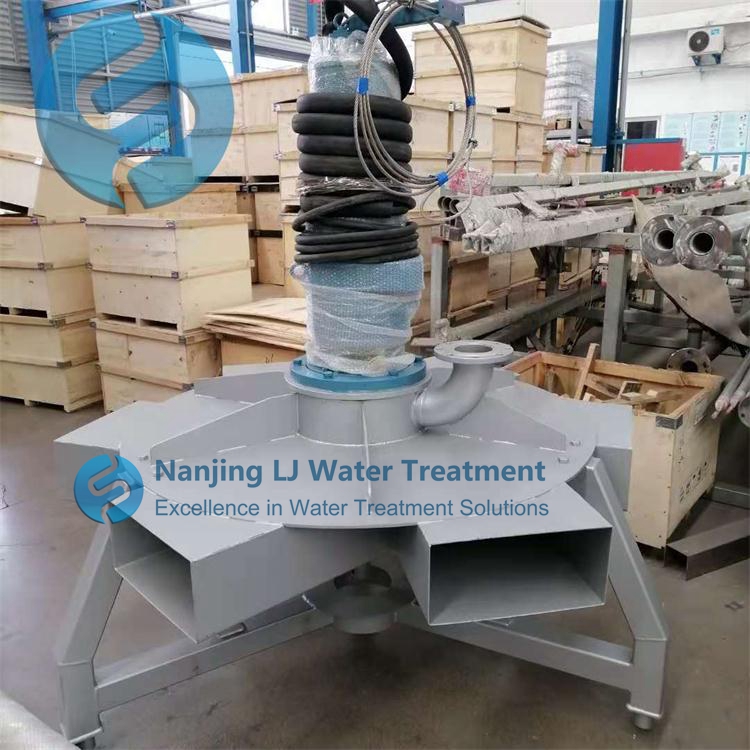
Aeration mixers are widely used in water treatment and aquatic ecosystem management to keep water bodies in continuous motion while introducing sufficient dissolved oxygen. Their working logic is built on the interaction between air injection and water flow guidance, which avoids the dead zones that often appear in static water ponds, lakes and industrial storage tanks.
How Air Release Drives Initial Water Movement
Fine bubbles are continuously released from the submerged diffuser units connected to the bottom of the mixer. As these air bubbles rise upward, they create a density difference between the water around the bubble stream and the surrounding static water. This density gap pushes the water mixed with air to move upward at a steady speed, forming an initial vertical flow that carries low-oxygen water from deeper layers all the way to the surface. The rising bubble column also generates a low-pressure zone around its path, which pulls more surrounding water into the upward flow to fill the empty space left by the moving water mass.
Flow Diversion and Horizontal Spread at the Water Surface
When the upward water flow reaches the open water surface, it can no longer move higher and starts to spread out in all horizontal directions. The specially designed flow guiding structure on the top of the mixer helps convert the vertical momentum of the rising water into horizontal thrust, pushing the surface water to travel dozens of meters away from the equipment position. This outward moving surface flow creates a new pressure difference between the area near the mixer and the far shore of the water body, which pulls the deeper water from the outer zones back toward the bottom of the mixer to start a new circulation path.
Sustained Large-Scale Water Circulation Formation
As the air injection and flow diversion process runs continuously, the small local flow around each mixer gradually connects with adjacent flow paths to form a large closed loop across the entire water body. Water from the bottom sediment layer, the middle water column and the surface layer keeps exchanging positions at a controlled speed, so no single section of water stays static for a long time. This continuous mixing also prevents suspended solids from settling completely on the bed, and helps evenly distribute dissolved oxygen to every corner of the water body without relying on extra high-power pumping systems. The whole process maintains a gentle but steady flow velocity that will not damage the natural structure of aquatic habitats while supporting long-term water quality improvement.
Post time:2026-07-13
