Aeration Mixer Installation in Shallow Water: What Nobody Tells You Before You Start
Shallow water changes everything. The same mixer that runs perfectly in a 4-meter-deep basin starts behaving like a different machine when the water drops below 1.5 meters. The flow pattern collapses, the impeller breathes air, the thrust vector points upward instead of downward, and the whole system loses its ability to keep solids suspended. Most installation guides treat shallow water as an edge case. It is not an edge case. It is a completely different installation problem that demands its own set of rules.
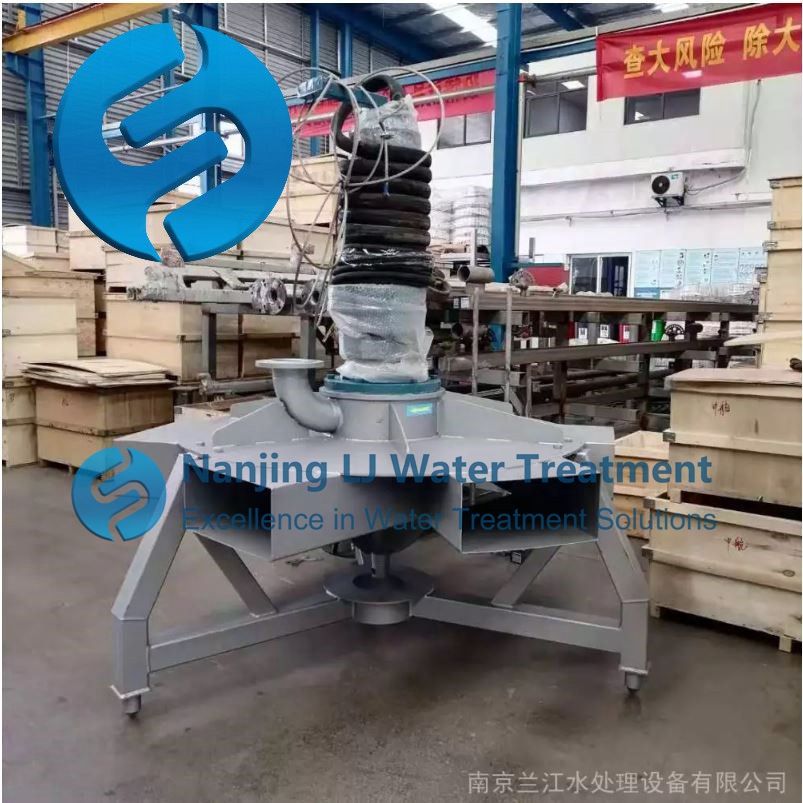
What Actually Changes When the Water Gets Shallow
The Impeller Starts Pulling Air Instead of Pushing Water
In deep water, the impeller sits well below the surface and pushes a solid column of water downward. In shallow water, the impeller gets too close to the surface. The pressure drop at the blade tips drops below the vapor pressure of the water, and the impeller starts cavitating. It pulls air down into the water column instead of pushing water down.
This is not a minor inefficiency. Air entrainment kills the oxygen transfer rate. The mixer looks like it is running hard, drawing full current, but the basin is not getting aerated. The water turns milky white from the air bubbles, and operators panic because it looks like something is wrong. Nothing is mechanically wrong. The installation is wrong for the depth.
The fix starts before you even pick up a wrench. You have to select a mixer with a higher thrust-to-power ratio specifically rated for shallow operation, or you have to reduce the submergence depth by using a shorter riser so the impeller stays far enough below the surface even at low water levels.
Surface Vortexing Destroys the Flow Pattern
When the impeller is too close to the surface, it creates a vortex. That vortex pulls surface water down and spits it back out radially. The horizontal flow component that you need to sweep the basin floor disappears. Instead of a clean circulation pattern, you get a washing machine effect that churns the surface but leaves the bottom untouched.
Sludge settles faster than the mixer can resuspend it. The basin looks clean on top but the floor is covered in a layer of dead solids within weeks. Operators blame the mixer. The mixer is fine. The depth was never accounted for in the layout.
Mounting and Positioning Rules for Shallow Basins
Keeping the Impeller Below the Critical Depth
The general rule is simple: the impeller must stay at least 0.3 meters below the lowest expected water level at all times. That means if your basin operates between 0.8 meters and 1.5 meters deep, the impeller needs to sit no higher than 0.5 meters from the bottom.
This often means using a shorter riser pipe or a surface-mounted bracket instead of a floor-mounted riser. A surface-mounted bracket lets you lower the impeller without digging into the basin floor, which is useful when the basin has a concrete slab or a liner that you do not want to penetrate.
If you cannot get the impeller low enough because of basin geometry, switch to a mixer with a smaller impeller diameter. A smaller impeller generates less upward thrust at the same power level and stays submerged more easily. The trade-off is reduced flow coverage per unit, so you will need more mixers to cover the same area.
Anchor Placement When There Is No Depth to Work With
In deep water, you can drop an anchor to the bottom and let the mooring line take up the slack. In shallow water, there is no bottom to drop to. The anchor sits right next to the mixer, and the mooring line has almost no catenary to absorb shock loads.
Use deadweight anchors instead of drag anchors. A cinder block or a concrete weight sitting on the basin floor provides holding power through mass, not through embedment. For floating mixers in shallow basins, the mooring lines must be much shorter than in deep water, and the anchor spacing must be tighter to prevent the unit from drifting into the walls.
Do not rely on a single anchor point. Shallow water means less hydrostatic pressure holding things in place. A two-point mooring system with both anchors on opposite sides of the mixer gives you redundancy. If one anchor shifts, the other one holds.
Cable and Electrical Considerations Unique to Shallow Water
Gland Placement Above the Waterline
This is the one detail that kills more shallow-water installations than anything else. The cable gland must sit above the highest water level, not below it. In deep water, you can bury the gland at the basin floor and run the cable up through a riser. In shallow water, there is no room for that. The gland has to be mounted on the mixer housing or on a bracket that keeps it dry.
If the gland sits at or below the waterline, it will flood every time the water level rises. Even a gland rated to IP68 will eventually leak if it is submerged for months at a time while the mixer vibrates. The vibration works the seal loose. Water gets in. The insulation fails. You pull the mixer out and find a corroded cable that should have lasted ten years.
Mount the gland on the top side of the mixer housing, point it downward so any condensation runs away from the seal, and use a drip loop in the cable before it enters the gland. That drip loop prevents water from running along the cable jacket and into the gland entry point.
Short Cable Runs and Junction Box Placement
Shallow basins usually mean short cable runs from the control panel to the mixer. That sounds like a good thing. It is, until you realize that the junction box also has to stay dry. Do not bury the junction box in the basin floor. In shallow water, the box will be underwater during normal operation.
Mount the junction box on the basin wall above the high-water mark. Run the cable from the mixer up to the box in a vertical riser, not along the floor. A vertical riser keeps the cable off the basin bottom where sludge accumulates and where cleaning equipment can snag it.
