Aeration Mixer Cluster Installation Layout: A Field-Proven Approach
Getting the layout right for a cluster of aeration mixers is not about spacing them evenly and hoping for the best. A poorly arranged cluster wastes energy, leaves dead zones where sludge accumulates, and creates interference patterns that cancel out the very flow you are paying to generate. The difference between a layout that performs for twenty years and one that fails in two comes down to geometry, spacing rules, and how each unit's cone of influence interacts with its neighbors.
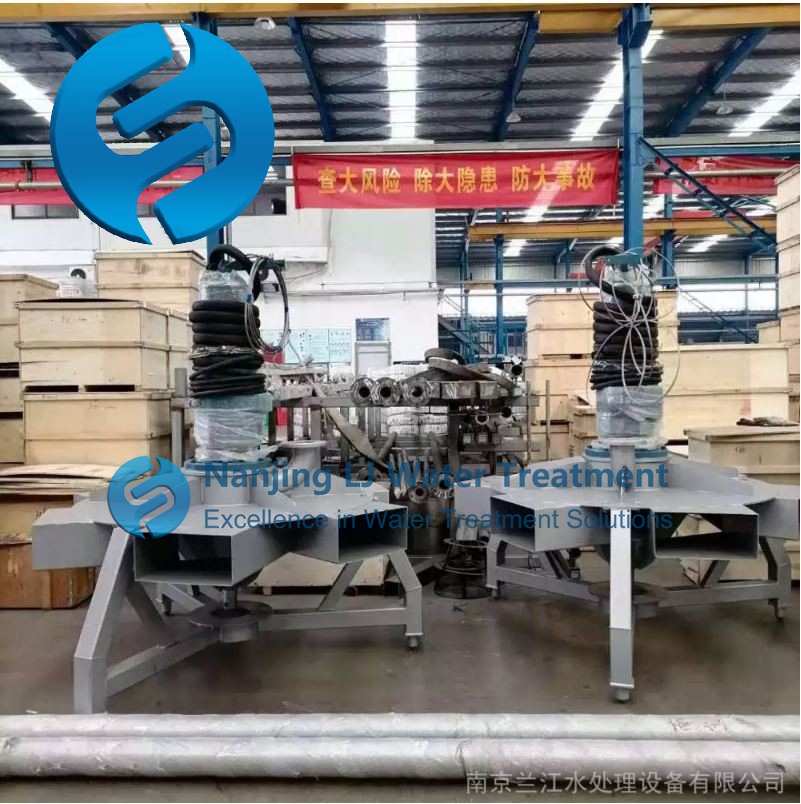
Why Cluster Layout Gets Wrong So Often
Most installers default to a grid pattern because it looks clean on paper. Every mixer sits at the intersection of evenly spaced rows and columns. Easy to design, easy to install, easy to explain to a client. But here is the problem nobody talks about enough: in a grid layout, the thrust vectors from adjacent mixers run parallel to each other. They do not cancel, but they do not help each other either. Each mixer works inside its own little cell, and the water at the cell boundaries barely moves.
If your basin has any asymmetry — an inlet on one side, a sloped floor, a wall cutting across the flow — the grid pattern cannot adapt. One side of the basin gets too much flow while the other side starves. The result is uneven treatment, localized sludge buildup, and a system that never reaches its design capacity.
The real goal is to tile the cones of influence across the entire basin floor so there are no gaps and no overlaps that cause destructive interference. Every mixer creates a roughly elliptical zone where the flow velocity is high enough to keep solids suspended and transfer oxygen. Outside that cone, the water is essentially dead. Your job is to make sure those cones cover every square meter of the basin.
Spacing Rules That Actually Work
Center-to-Center Distance Based on Impeller Diameter
Forget basin dimensions for a moment. The most reliable spacing rule is based on impeller diameter, not on tank size.
For axial-flow mixers, space units at 2.5 to 3 times the impeller diameter center-to-center in a staggered pattern. A 500-millimeter axial impeller should sit 1.25 to 1.5 meters apart from its neighbors. For radial-flow mixers, use 2 to 2.5 times the impeller diameter because radial impellers throw water farther and their cones of influence are wider. A 500-millimeter radial impeller can be spaced 1.0 to 1.25 meters apart.
Tighter spacing works in shallow basins where the flow does not have room to develop. Wider spacing is needed in deep basins where the flow column is tall and the cone extends farther downward. A mixer with a 600-millimeter impeller covers a circle roughly 1.2 meters wide. Place the next mixer 2.4 meters away center-to-center and the cones just touch — no gap, no overlap.
Staggered Versus Grid: The Verdict
A staggered layout puts each mixer in the gap between two upstream units. This forces the flow from every mixer to push diagonally across the basin instead of straight into the next unit. The result is full basin coverage with minimal interference.
In a basin with an inlet on one end, orient the staggered rows so the mixers face the flow direction. This creates a sweeping pattern that carries solids from the inlet toward the outlet instead of letting them settle in the corners.
For basins deeper than 4 meters, consider a two-layer staggered arrangement. Mixers on the upper layer handle surface circulation while lower-layer units push water along the bottom. The vertical offset should be at least 1.5 times the impeller diameter to prevent the upper cone from collapsing into the lower one.
Mooring and Anchoring for Cluster Units
Three-Point Mooring Systems
Every mixer in a cluster needs to stay exactly where you put it. Vibration, thrust, and water current will shift an unsecured unit within weeks. The standard solution is a three-point mooring system — three anchor lines spaced 120 degrees apart around the unit.
For floating mixers, use stainless steel cable or nylon rope rated for the expected current load. The anchors can be duckbill anchors driven into the basin floor, rebar stakes, or cinder blocks with sufficient mass. For submerged mixers, the same three-point principle applies but the anchors attach to the basin bottom or to a dedicated riser pipe.
The mooring lines must have enough slack to absorb the full thrust range of the mixer at maximum speed. A line that is too tight transfers vibration directly to the anchor, which pulls loose over time. A line that is too loose lets the unit drift and tangle its cable with neighbors.
Cable Routing Between Cluster Units
When multiple mixers share a power feed from a single control panel, the cable routing becomes a layout decision. Bury the cable in conduit or trench it along the basin rim. Do not drape cables across the basin floor where they can snag on impellers or get crushed under mounting hardware.
Leave a service loop at every mixer connection point. A minimum bending radius of 0.5 meters prevents stress on the gland during thermal expansion. If one mixer in the cluster needs to be pulled for maintenance, the cable slack at adjacent units must be enough to reach it without disconnecting the whole feed.
Adjusting for Basin Shape and Operating Mode
Irregular Basins and Multiple Cells
Rectangular basins are the easy case. Irregular shapes, multiple cells, or baffled configurations demand a different approach. Visual inspection of flow patterns is critical to identify areas where circulation is weak. Drop a tracer dye or float and watch where it goes before you finalize the layout.
For multi-cell basins, treat each cell as its own cluster but coordinate the timing so adjacent cells do not push against each other. Running all mixers at full speed simultaneously in connected cells creates opposing currents that cancel out in the shared wall zone. Stagger the operation or reduce speed on the boundary units.
