Aeration Mixer Adaptation Scenarios for Industrial Wastewater Treatment: Matching Equipment to the Job
Industrial wastewater does not behave like municipal sewage. It throws high suspended solids at your equipment one day, corrosive chemicals the next, and foam that kills oxygen transfer the day after that. An aeration mixer that runs flawlessly in a city treatment plant will choke, corrode, or fail within months in a chemical or food processing basin. The trick is not finding the most powerful mixer. It is finding the one built for what your water actually does.
Why Industrial Wastewater Breaks Standard Aeration Mixers
The Composition Problem
Municipal wastewater has organic matter and suspended solids, but the range is predictable. Industrial wastewater can contain heavy metals, solvents, high salinity, extreme pH swings, and fats that coat every surface they touch. A mixer designed for a steady diet of household sewage cannot handle a feed stream that shifts from pH 3 to pH 11 between batches.
The real killer is suspended solids. In steel and mining wastewater, SS concentrations can hit 500 mg/L or higher. Those solids settle on impeller blades, clog air passages, and unbalance the rotor within weeks. A mixer that cannot handle that load is not a cost-saving device. It is a liability.
The Corrosion Problem
Chemical and printing/dyeing wastewater eat equipment alive. Chlorides, sulfides, and organic acids attack metal housings, degrade seals, and dissolve gaskets. A standard carbon steel mixer in a dyeing plant will not last two years. The materials have to match the chemistry, not just the flow rate.
High Suspended Solids Environments: Steel, Mining, and Papermaking
What the Water Actually Does to the Mixer
In steel plant effluent and mining wastewater, the solids do not just sit there. They settle fast, they abrade surfaces, and they accumulate around the impeller hub until the unit cannot turn. The mixer has to generate enough thrust to keep everything in suspension while resisting the wear that those same solids cause.
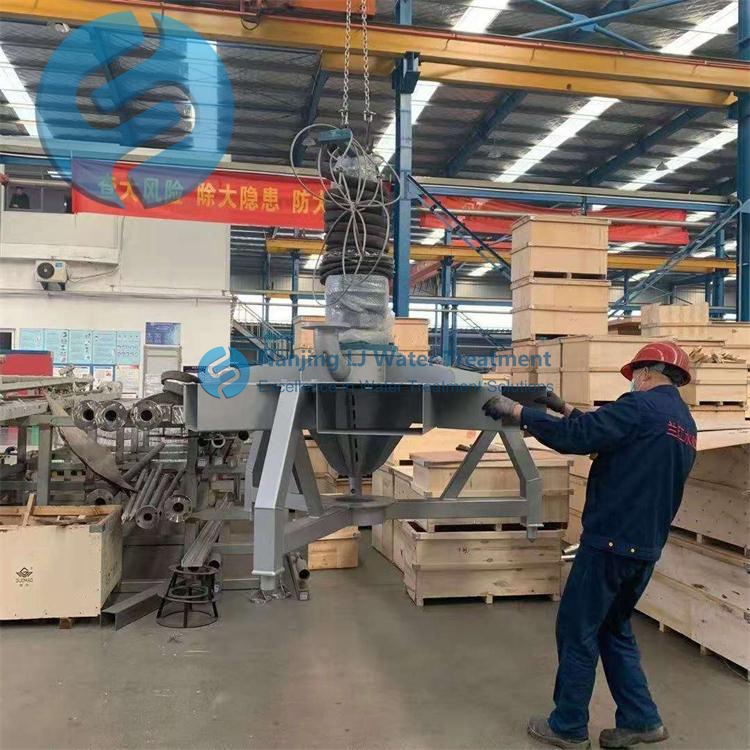
Spiral aeration mixers handle this better than most alternatives. The design uses the airflow itself to create a self-cleaning circulation pattern. Gas enters from the bottom, creates an airlift effect, and the resulting liquid circulation pushes solids away from the mixing zone. In documented cases, spiral aeration mixers running in steel wastewater with inlet SS at 500 mg/L operated for over three years without a single clogging event. That kind of uptime is not theoretical. It is what the field data shows.
Material Selection for Abrasive Streams
When solids are high, the mixer housing and impeller need to be hard enough to resist abrasion but tough enough to avoid cracking under vibration. Stainless steel or reinforced polymer housings are the standard answer. Do not use cast iron in a slurry environment. It will crack, and when it cracks, the seal fails, and the whole unit goes underwater.
High Concentration Organic Loads: Pharmaceutical and Food Processing
The Oxygen Demand Challenge
Pharmaceutical and food processing wastewater carries massive BOD loads. The microorganisms need oxygen fast, and if the mixer cannot deliver it, the treatment process stalls. Ammonia spikes, COD climbs, and the effluent fails compliance.
The mixer in these applications has to do two things simultaneously: push a lot of air into the water and keep the sludge suspended so every bacterium stays in contact with that oxygen. Micro-pore aeration devices paired with hydrolysis acidification pretreatment have shown documented results where COD removal rates climbed from 85 percent to 95 percent, and aeration energy dropped by 18 percent compared to conventional setups.
Foam and Fat Management
Food processing wastewater generates fat and grease that float to the surface and coat the impeller. A coated impeller is an unbalanced impeller. The vibration destroys bearings within months. The mixer has to break up that fat layer and keep it emulsified long enough for the bacteria to consume it. Jet-type aeration mixers handle this better than submerged units because the high-velocity discharge shears the fat layer apart before it can accumulate.
Corrosive and Extreme pH Environments: Chemical and Printing/Dyeing Plants
Surviving pH 3 to pH 11
Printing/dyeing wastewater swings between acidic and alkaline depending on the dye batch. A mixer that survives one end of that range will dissolve at the other. EPDM membrane aeration devices have been documented to last over three years in pH 3 to 11 environments, far outlasting standard rubber components.
The housing material matters just as much as the seal. Stainless steel 316L or fiberglass-reinforced polymer housings resist the chloride attack that destroys carbon steel. Do not skimp on materials here. A failed seal in a corrosive basin means the motor shorts out, and replacing a submerged motor in a chemical tank is not a four-hour job. It is a multi-day outage.
Anti-Blocking in Scaling Conditions
Chemical wastewater often carries hardness ions that precipitate as scale on aeration surfaces. Carbonate and sulfate scaling reduces oxygen transfer over time. The mixer has to either resist scaling or tolerate it without performance loss. Spiral aeration mixers have a documented advantage here: the self-cleaning circulation pattern reduces scale buildup, and the large gas passages do not clog the way micro-pore devices do. In high-hardness, high-salinity wastewater, this advantage becomes the deciding factor.
