Aeration Mixer Application Scope in Wastewater Treatment Plants: Where They Actually Belong
Every wastewater treatment plant has zones that need mixing. Not all zones need aeration. Not all zones need the same type of mixing. The aeration mixer sits at the intersection of these demands, and knowing exactly where it fits — and where it does not — saves money, avoids downtime, and keeps the biological process running the way it was designed.
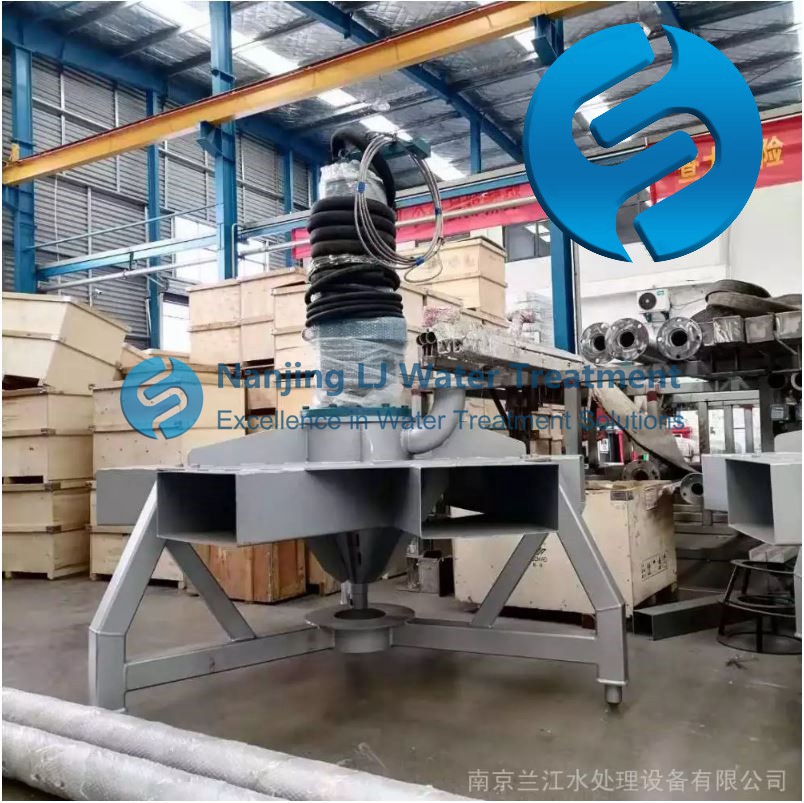
Where Aeration Mixers Show Up Inside a Treatment Plant
Activated Sludge Basins and Oxidation Ditches
This is the most common application by far. In an activated sludge system, the mixer does two things at once: it pushes dissolved oxygen into the mixed liquor, and it keeps the sludge suspended so it does not settle to the bottom and die.
The oxygen demand here is constant. Microorganisms are eating organic matter around the clock, and if the dissolved oxygen drops below 1.5 to 2.0 mg/L, the process stalls. Ammonia does not get nitrified. BOD does not get removed. The effluent fails compliance.
In oxidation ditches, the mixer also provides the directional flow that moves wastewater around the loop. Without it, the ditch becomes a stagnant pond with dead zones at the bends. The mixer keeps the whole channel moving in one direction at a controlled velocity, usually between 0.25 and 0.35 meters per second.
SBR and Sequencing Batch Reactors
Sequencing batch reactors run on a fill-and-draw cycle. During the fill phase, the mixer keeps incoming wastewater from stratifying. During the react phase, it provides aeration for BOD removal and nitrification. During the settle phase, the mixer shuts off so the sludge can drop out cleanly.
This on-off cycling is hard on equipment. The mixer has to start and stop repeatedly without losing alignment or burning out the motor. That is why SBR applications demand mixers with robust start-stop capability and reliable sealing at the cable entry point.
The same unit often handles mixing during the anoxic phase as well. When the SBR switches to denitrification mode, the mixer runs without aeration, just pushing the water around to keep the carbon source in contact with the nitrate. One machine, two jobs, zero downtime between cycles.
Sludge Stabilization and Digestion Tanks
After primary and secondary treatment, the leftover sludge still contains organic matter. Aerobic digestion tanks use mixers to keep that sludge in suspension while bacteria break it down further. The mixer here does not need to push much oxygen. It needs to prevent the sludge from forming a hard crust on top or a solid block on the bottom.
In anaerobic digesters, the mixer serves a different purpose. It breaks up scum layers, distributes heat evenly, and keeps the bacteria in contact with the substrate. No oxygen is involved, but the mixing demand is just as high. A mixer that cannot handle solids-heavy sludge will clog within weeks in a digestion tank.
Industrial Wastewater Applications That Push Mixers Harder
Chemical and Pharmaceutical Plants
Industrial wastewater is not like municipal sewage. It can contain high concentrations of suspended solids, variable pH, toxic compounds, and compounds that foam aggressively. A mixer in a chemical plant has to handle all of that without failing.
In nitrification and denitrification zones at chemical plants, the mixer must maintain precise dissolved oxygen levels. Too much oxygen kills the denitrifying bacteria. Too little oxygen stops nitrification. The mixer has to respond quickly to load changes, which means variable speed drives are almost mandatory in these applications.
Some chemical plants use the mixer for lime removal as well. Lime scale builds up on fixed diffusers and clogs them within months. A mechanical mixer does not have that problem because there are no small holes to clog. The impeller pushes water directly, and the scale does not stick the same way it does on a membrane diffuser.
Paper Mills and Food Processing
Paper mill wastewater carries fiber, fillers, and residual chemicals that settle fast. A mixer that does not generate enough horizontal flow will let the fiber accumulate in corners and under equipment. The result is a basin that looks clean on top but is clogged underneath.
Food processing plants deal with high BOD loads and fats that float. The mixer has to break up the fat layer and keep it emulsified long enough for the bacteria to eat it. If the fat is not mixed, it coats the impeller, unbalances the unit, and causes vibration that destroys bearings within months.
In both industries, the mixer often runs in facultative aerated tanks where oxygen is needed part of the time but not all of the time. The ability to switch between aeration and pure mixing without changing equipment is a major advantage here.
Applications Outside the Main Treatment Train
Equalization Basins and Lagoons
Equalization basins exist to smooth out flow and load spikes. The mixer keeps the incoming wastewater from separating into layers — heavy solids on the bottom, grease on top, clear water in the middle. Without mixing, the downstream process gets shocked by concentration spikes instead of a steady feed.
Lagoons are the low-tech end of the spectrum. They are shallow, they are wide, and they rely on natural aeration supplemented by mechanical mixers. The mixer in a lagoon does not need to push much oxygen. It needs to cover a large area and prevent short-circuiting, where wastewater flows straight from inlet to outlet without being treated.
A single mixer in a large lagoon can cover a radius of 10 to 15 meters depending on the impeller size. Multiple mixers in a cluster pattern ensure the entire lagoon stays active. The spacing follows the same cone-of-influence rules as in a mechanical basin, but the depths are shallower and the currents are weaker.
