Pre-Buried Base Installation for Aeration Mixers: What the Field Demands
The pre-buried base is the foundation of every aeration mixer installation. If the base is wrong, everything above it is wrong. Cracked concrete, shifted bolts, uneven elevation — these are not minor inconveniences. They destroy oxygen transfer efficiency, shorten equipment life, and turn a simple retrofit into a nightmare.
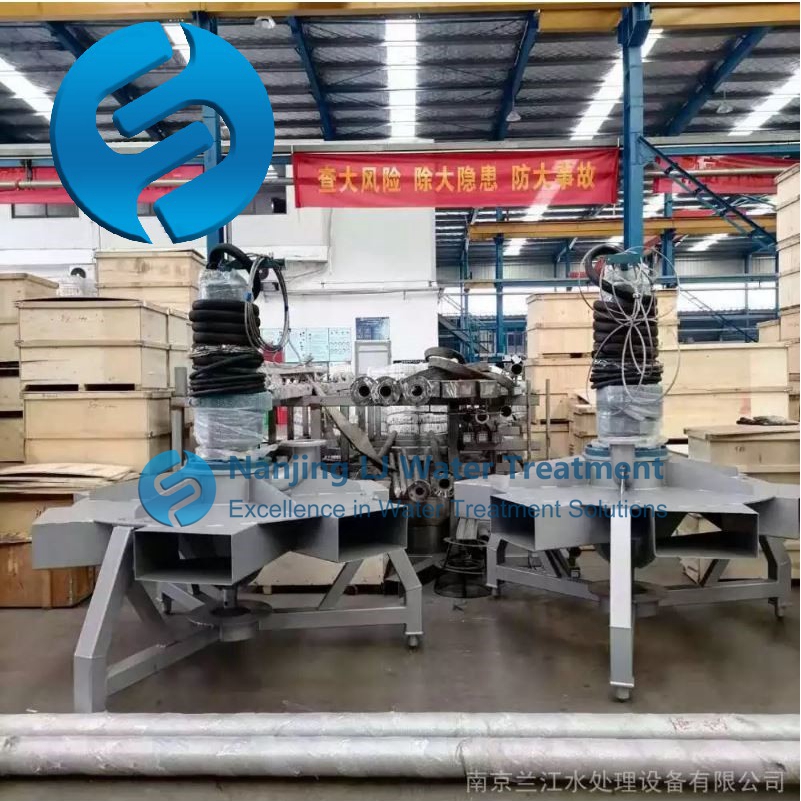
This article covers the actual installation requirements that experienced contractors follow when setting pre-buried bases for aeration mixers in wastewater treatment plants.
Why Pre-Buried Bases Fail and How to Prevent It
Most base failures come from three root causes: poor concrete mix, wrong rebar placement, and ignoring the chemical environment inside the tank.
Wastewater is corrosive. Sulfates, chlorides, and organic acids eat through standard concrete in under five years. If you use plain Portland cement without any additive, you are building a time bomb. The concrete will spall, the anchor bolts will loosen, and the mixer will sit crooked.
The second killer is rebar. Many installers skip rebar entirely because they think the base is small and does not need reinforcement. That is wrong. Even a 300 mm × 300 mm base needs a minimum rebar cage. Without it, the concrete cracks under the vibration load from the mixer during operation.
The third issue is elevation drift. Concrete shrinks as it cures. If you do not account for that shrinkage, the finished surface ends up 5 to 10 mm lower than the design elevation. That small difference throws off the entire mixer alignment.
Concrete Mix Design and Material Requirements
Cement and Aggregate Specifications
The concrete for pre-buried bases must meet a minimum compressive strength of C30 (30 MPa) at 28 days. Use Portland cement Type II with sulfate resistance — not Type I, which degrades fast in wastewater environments.
The aggregate should be crushed stone, not river sand. River sand has too much silt content, which increases water absorption and weakens the final mix. Maximum aggregate size: 20 mm. Water-cement ratio must stay below 0.45. Anything higher and the concrete becomes porous, which lets wastewater seep in and attack the rebar from inside.
Add silica fume at 5% to 8% by cement weight. This fills the micro-pores in the concrete and dramatically improves resistance to sulfate attack. It also increases early strength, which lets you install the mixer sooner.
Rebar Cage Construction
Every pre-buried base needs a rebar cage. Minimum specification:
4 bars of HRB400, 12 mm diameter, tied into a square cage
Stirrups at 150 mm spacing along the full height of the cage
Cage height must extend 50 mm above the concrete pour line so the anchor bolts can be cast in place
Clear cover: minimum 40 mm on all sides (this is non-negotiable in corrosive environments)
Do not weld the rebar cage. Use binding wire. Welding creates heat-affected zones that corrode faster than the surrounding steel.
Anchor Bolt Placement and Alignment Tolerances
<h3 style="box-sizing: border-box; --univer-tw-border-spacing-x: 0; --univer-tw-border-spacing-y: 0; --univer-tw-translate-x: 0; --univer-tw-translate-y: 0; --univer-tw-rotate: 0; --univer-tw-skew-x: 0; --univer-tw-skew-y: 0; --univer-tw-scale-x: 1; --univer
Post time:2026-06-09
