Aeration Mixer Tilt Angle Standards: What Engineers Actually Use on Site
Most people focus on spacing when installing aeration mixers. Nobody talks enough about tilt angle. That is a mistake. The angle at which a mixer sits in the tank determines how bubbles rise, how the flow field spreads, and whether your dissolved oxygen stays uniform across the whole basin. Get the angle wrong and you get short-circuiting, dead zones, and wasted air.
This article covers the actual tilt angle standards used in wastewater treatment plants around the world — not textbook theory, but what works on the ground.
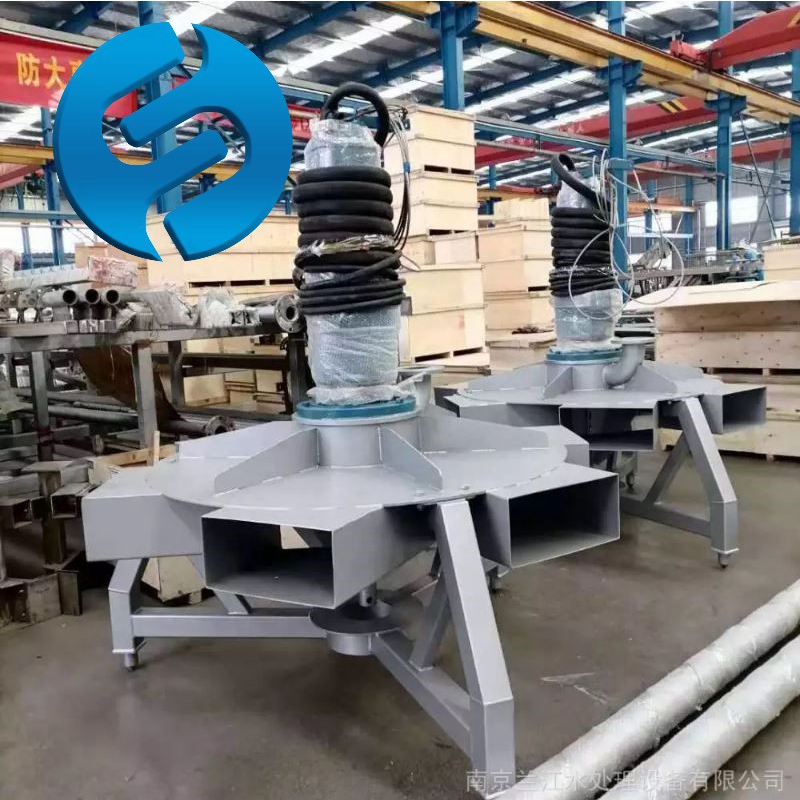
The Science Behind Tilt Angle in Aeration Mixers
Bubbles do not rise straight up when a mixer is tilted. They follow the surface normal of the diffuser disc. A flat disc (zero tilt) pushes bubbles vertically — good for shallow tanks but terrible for deep basins because the bubbles travel too far before they disperse. A tilted disc redirects the bubble plume laterally, which improves horizontal mixing and reduces the vertical distance bubbles need to travel.
The key metric here is the oxygen transfer efficiency (OTE). Research from multiple pilot plants shows that OTE peaks when the diffuser surface sits at an angle between 15° and 30° from horizontal. Below 10°, you get vertical plumes with poor lateral spread. Above 35°, bubbles slam into the tank wall or the water surface too aggressively, causing splash loss and foam buildup.
That sweet spot — 15° to 30° — is not a suggestion. It is backed by field data from thousands of installations across municipal and industrial wastewater systems.
Standard Tilt Angles by Mixer Configuration
Fixed-Mount Disc Aerators
For fixed-mount disc aerators, the most common tilt angle is 20° to 25° from horizontal, with the disc angled toward the incoming water flow. This orientation forces the bubble plume downstream, which improves contact time between oxygen and the bulk liquid.
If the tank has a lateral flow pattern (water moves side to side), tilt the disc perpendicular to the flow direction — not parallel. Parallel tilt just pushes bubbles along the same path the water already takes. Perpendicular tilt creates cross-flow turbulence, which is what you actually need for uniform DO distribution.
The mounting bracket should allow ±3° adjustment after initial installation. Concrete settles, pipes shift, and tanks deform slightly over time. That adjustment range gives you room to correct drift without pulling the unit out.
Submersible Jet Mixers
Jet mixers operate on a completely different principle. They do not use diffuser discs — they use high-velocity liquid jets. For these units, the tilt angle refers to the nozzle orientation relative to the tank floor.
Standard practice calls for a nozzle tilt of 10° to 15° downward from horizontal. Pointing the jet slightly downward keeps the flow attached to the tank bottom, which maximizes scouring and prevents the jet from punching through the water surface and wasting energy on splash.
For tanks deeper than 4 meters, increase the downward tilt to 15° to 20°. The deeper the water column, the more the jet loses momentum before it reaches the bottom. A steeper angle compensates for that energy loss.
Tubular Aeration Devices
Tubular aerators sit on the tank floor and blow air through perforated pipes. The pipe itself should be leveled, but the air outlet direction matters. Standard installation calls for the perforations to face upward at 15° to 20° from vertical — not straight up.
