Why Precision Matters: Sizing a Top Entry Mixer for High-Density Biomass Nutrients
In the water treatment industry, "one size fits all" is a dangerous assumption. At LJ Water Treatment, we recently handled a technical challenge involving Biomass Nutrient (Centrate/G2D) mixing that perfectly illustrates why fluid density and viscosity change everything.
The Challenge: Same Tank, Different Physics
A client required mixing solutions for two identical tanks 1300 mm diameter, 2300mm depth. However, the media properties were worlds apart:
● Case A: Low viscosity 5 cP, standard density.
● Case B: High viscosity 70 cP with a high density of 1.53 kg/L.
The client initially requested a standard 2-blade double-layer impeller for both. While 2-blade designs are common, our engineering team knew that for a 2300 mm deep tank, stability was the primary concern.
Technical Analysis: Why We Recommended the Upgrade
1. From 2-Blade to 3-Blade: Solving the Vibration Issue
Although the client requested a 2-blade impeller, we successfully advised them to switch to a 3-blade double-layer impeller (JBJ-500/700).
● The Science: 3-blade impellers provide a more balanced hydraulic distribution. In deep tanks 2 meters, a 2-blade impeller can create pulsing flows that lead to mechanical vibration.
● The Result: The 3-blade design ensures a smoother, more stable operation, significantly extending the lifespan of the motor and gear reducer.
2. Handling High Density (1.53 kg/L)
Density is a multiplier for force. With a density 50% higher than water, the radial loads on the mixer shaft are immense.
● Shaft Diameter Upgrade: For the 70 cP / 1.53 density medium, we increased the shaft diameter to 60 mm (compared to 45 mm for the lighter medium).
● Power Adjustment: We utilized a2.2 kW motor at 43 rpm to provide the necessary torque to move the heavy biomass nutrient without overloading the system.
The Engineering Logic: Power and Torque
To ensure the top entry mixer performs reliably, we calculate the required Power (P) based on the Power Number (N_p) and density:
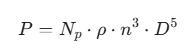
As density increases to 1.53, the power demand rises proportionally. This is why our JBJ-700 configuration uses a thicker shaft and a higher-power motor to handle the mechanical stress.
Conclusion: Expertise You Can Trust
By choosing LJ Water Treatment, the client received more than just equipment—they received an optimized engineering solution. All wetted parts were manufactured from AISI 316L to ensure corrosion resistance against TCI and Plant Water (G2D) media.
Whether you are dealing with 5cPor 70 cP, our team ensures your top entry mixer is built for stability, efficiency, and longevity.
Post time:2026-03-16
