Optimizing Flocculation Performance: Why Tank Geometry Dictates Your Top Entry Mixer Selection
In wastewater treatment, achieving the perfect chemical reaction isn't just about the additives—it’s about the physics of the movement. LJ Water Treatment Equipment Co., Ltd., a leading top entry mixer manufacturer, recently completed a technical review for a specialized flocculation tank project. We are glad to share this case.
When dealing with a "tall and narrow" tank geometry (where the height-to-diameter ratio is high, such as 1.8), standard mixing solutions often fall short. Without the right top entry mixer, these tanks are prone to fluid stratification, leading to "dead zones" where chemicals settle and the flocculation process fails.
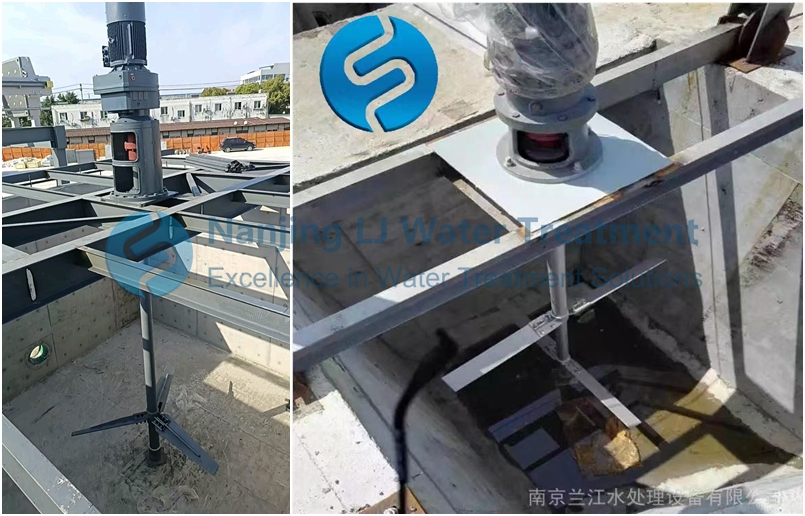
The Engineering Challenge: Overcoming Stratification
For a tank with a diameter of 1.3m and a height of 2.3m, ensuring uniform top-to-bottom circulation is the primary demand. As a professional top entry mixer manufacturer, our technical team identified that a single-layer impeller would struggle to move fluid effectively across such a vertical span.
To solve this, LJ Water Treatment Equipment Co., Ltd. recommended a dual-layered approach. By utilizing a top entry mixer with a two-stage impeller system, the lower layer lifts fluid from the tank bottom while the upper layer maintains momentum through the mid-section, ensuring a stable axial flow.
Why the 3-Blade Design Wins in Flocculation
A common question we encounter is the choice between two-blade and three-blade impellers. For a high-performance flocculation mixer, the three-blade design is vastly superior for several reasons:
Flow Stability: It generates a smoother, more uniform flow compared to the pulsating, uneven movement of a two-blade mixers.
Energy Efficiency: For low-viscosity applications (approx. 5 cp), a three-blade system achieves better fluid motion.
Mechanical Longevity: More blades mean less vibration, protecting the mechanical seals and bearings for a longer service life.
For those requiring the most gentle yet thorough mixing, our paddle type top entry mixer is specifically designed to promote consistent floc formation without breaking the delicate particles.
Technical Specifications for the Recommended Solution
Feature | Specification |
Impeller Type | Two-tier, 3-blade (Axial Flow) |
Material | 316L Stainless Steel (Shaft, Impeller, Couplings) |
Primary Goal | Homogeneous full-tank circulation |
Application | Low-viscosity Flocculation |
Partner with the Experts
Selecting the right flocculation mixer is a balance of fluid dynamics and mechanical reliability. At LJ Water Treatment Equipment Co., Ltd., we don't just sell machines; we provide process-effective solutions tailored to your specific tank dimensions and chemical requirements.
Whether you are looking for a heavy-duty industrial setup or a precision-engineered top entry mixer, our team is ready to assist with power ratings, speed control, and material selection.
Need a customized mixing solution?
Visit the LJ Water Treatment Equipment Co., Ltd. home page today to explore our full range of water treatment technologies or contact our engineers for a technical consultation.
Post time:2026-04-07
