Aeration Mixer Series Connection Standards: Linking Multiple Units in Sequence Without Killing Performance
Connecting aeration mixers in series sounds like a simple idea — put one after another along the flow path, let the first unit push water into the second, and so on. In theory, the mixing energy stacks up. In practice, series connections fail more often than parallel arrays because the interaction between units is far more complex. The downstream mixer sees disturbed water, not clean water. The upstream mixer fights backpressure from the downstream unit. And if the spacing, alignment, or coupling is off by even a little, the whole chain underperforms a single properly sized unit.
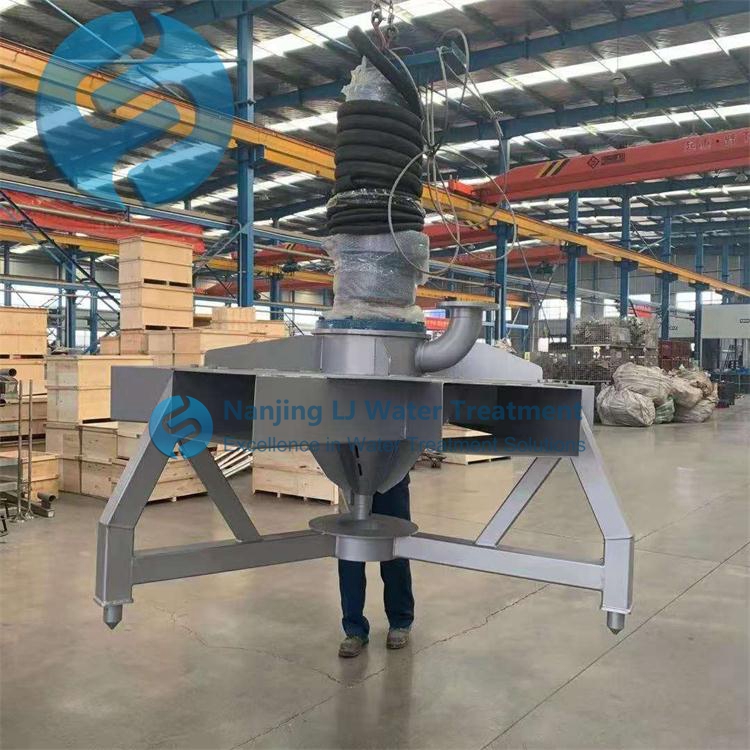
Series connection is the right choice for long channels, plug flow basins, and extended aeration systems where water must travel a long distance. But it demands a different set of rules than parallel installation. Most field guides treat series and parallel the same. They are not the same.
When Series Connection Actually Makes Sense
Series is not always better. It is not always worse. It makes sense in specific conditions and creates problems in others. Knowing the difference saves you from a design that looks good on paper and performs terribly in the field.
Long Narrow Basins Where Parallel Fails
In a basin that is 50 meters long and 5 meters wide, parallel installation puts mixers side by side across the width. The mixers on one side push water toward the mixers on the other side. The flow cancels in the middle and the ends get over-mixed. It is a mess.
Series connection solves this. Place the mixers one after another along the length. The first unit pushes water downstream. The second unit picks up that moving water and pushes it further. Each mixer works in water that is already in motion, which means it needs less thrust to achieve the same mixing effect. The energy adds up instead of canceling.
This is why series is the standard for oxidation ditches, plug flow reactors, and any basin where the length-to-width ratio exceeds 4:1.
Staged Oxygen Demand Reduction
Some basins have high oxygen demand at the inlet that drops sharply as the water moves downstream. A single oversized mixer at the inlet wastes energy in the downstream zones where demand is low. Series connection lets you size each mixer for the local demand — a large unit at the inlet, a medium unit in the middle, a small unit near the outlet.
The water arriving at each mixer has already been partially aerated by the upstream unit. The downstream mixer does not need to do the same work. It just needs to finish the job. This staged approach reduces total power consumption by 20 to 35 percent compared to a single oversized unit doing all the work.
Mechanical Coupling Between Series Units
The physical connection between mixers in a series chain is the most neglected part of the installation. Most people bolt each unit to the floor independently and call it a series connection. That is not series — that is just multiple units in a line with no mechanical relationship. True series connection means the units interact mechanically, and that interaction must be managed.
Shaft Coupling vs. Independent Mounting
In a true series chain, the impeller of the upstream unit pushes water directly into the suction zone of the downstream unit. The two flow fields overlap. This means the downstream mixer sees a non-uniform inflow — faster on one side, slower on the other. The impeller gets loaded unevenly, the shaft bends slightly, and the bearing on the high-load side wears faster.
The fix is a flexible coupling between the two shafts. Not a rigid coupling — a flexible one. The coupling absorbs the uneven loading and keeps the shafts aligned even when the flow is asymmetric. A jaw coupling or a disc coupling works well here. It handles the torque transmission while allowing a few degrees of angular misalignment that the uneven inflow creates.
Do not skip the coupling to save money. A rigid connection between two series mixers transmits every bit of flow asymmetry into the bearings. The downstream bearing fails within six months, and when it seizes, the upstream mixer loses its outlet — the backpressure spikes and its seal blows.
Transition Pieces and Flow Guides
Between the upstream mixer and the downstream mixer, install a transition piece — a short pipe or a flared duct that smooths the flow from the first impeller into the suction of the second. Without it, the downstream impeller sucks in a chaotic swirl of water. The swirl creates uneven loading, cavitation on one side of the impeller, and vibration that shows up as noise within weeks.
The transition piece should be 1.5 to 2 times the impeller diameter long. It tapers from the discharge diameter of the upstream unit to the suction diameter of the downstream unit. The taper angle should not exceed 15 degrees — steeper angles create flow separation and turbulence inside the duct, which defeats the purpose.
Spacing Rules for Series Chains
Spacing in a series chain is completely different from spacing in a parallel array. In parallel, you space units to avoid overlap. In series, you space units to let the flow develop between them. Too close and the downstream unit fights the upstream wake. Too far and the flow loses momentum before it reaches the next impeller.
Minimum Spacing Based on Wake Recovery
The wake behind an impeller — the zone of slow, turbulent water — extends 3 to 5 impeller diameters downstream. Within that zone, the water velocity is too low for effective mixing. If the downstream mixer sits inside that wake, it is pushing into dead water. Its thrust is wasted because there is no momentum to build on.
The minimum spacing between series mixers is 5 impeller diameters center-to-center. For a 600-millimeter impeller, that is 3 meters. For a 900-millimeter impeller, that is 4.5 meters. This gives the wake time to recover — the water velocity rebuilds to at least 60 percent of the impeller discharge velocity before it hits the next unit.
Maximum spacing is 8 impeller diameters. Beyond that, the flow loses too much energy between units. The downstream mixer has to work almost as hard as the first one, which defeats the purpose of staging. You end up with a chain of equally loaded units that could have been replaced by two larger units in parallel.
