Long-distance water pushing capacity of aeration mixers refers to the maximum effective horizontal and vertical flow distance that the two-phase gas-water mixed flow can reach in open water bodies, deep aeration tanks and large-scale water treatment basins. This performance indicator directly determines whether the system can eliminate hydraulic dead zones, achieve full-volume water circulation and maintain uniform dissolved oxygen distribution across the entire water area.
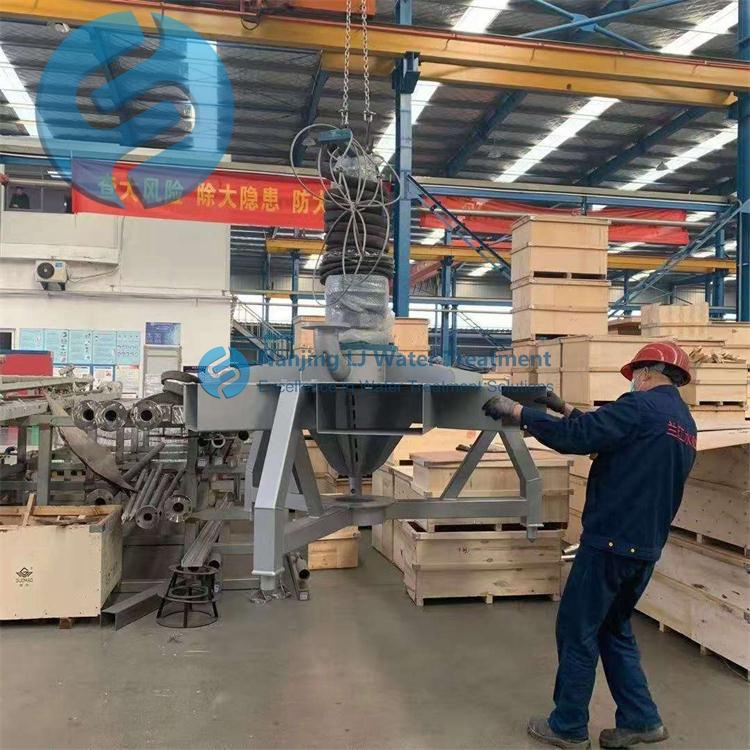
Core Fluid Dynamics Principles for Long-Distance Pushing
The long-distance water pushing performance is built on optimized axial flow momentum transmission and continuous flow field superposition. The high-speed gas-water mixed jet generated at the outlet carries strong kinetic energy that can drive surrounding static water to move forward together through entrainment effect. The streamlined flow channel design reduces flow resistance and energy loss during the transmission process, ensuring that the flow velocity can still maintain an effective level even at a position far away from the equipment installation point. The downflow intake structure near the water surface effectively avoids short-circuit flow, making the pushing force act on the entire water column from the surface to the bottom rather than only affecting a thin layer of surface water.
Key Parameters That Define Effective Pushing Distance
Multiple operational and structural parameters jointly determine the actual long-distance pushing range. The initial outlet velocity of the gas-water mixed jet is the most direct influencing factor, and a higher initial velocity can extend the effective pushing distance significantly. The submergence depth of the equipment also plays a critical role, as a proper installation depth close to the bottom can make full use of the entire water body space to form a continuous circulating flow that covers a much larger area. The water depth of the target basin will affect the flow attenuation rate, and in deeper water bodies, the pushing flow can maintain stable velocity for a longer distance without being quickly dissipated. The arrangement of multiple units in a coordinated layout can form a continuous superposition of flow fields, further expanding the total effective pushing coverage area without generating obvious turbulent dead zones.
Performance Optimization for Different Water Body Scenarios
Different application scenarios have specific optimization directions to maximize long-distance pushing capacity. In large open ponds and aquaculture water areas, the optimized flow pattern can make the effective pushing distance cover dozens of meters, realizing full water circulation and avoiding thermal stratification that may cause local anoxic zones. In long-strip municipal aeration tanks, the reasonable layout of flow pushing points can make the cross-flow velocity at the bottom of the tank stay above 0.5 feet per second, preventing activated sludge deposition at the far end of the tank. In river restoration projects, the continuous pushing flow can drive the water body to form a directional circulating flow, breaking the static state of stagnant water and extending the effective influence range of aeration far beyond the equipment installation area. All these scenario-based adjustments ensure that the long-distance water pushing capacity can match the actual hydraulic requirements of different water bodies.
Post time:2026-08-12
