Combined operation of aeration mixers and flow pushers has become a widely adopted strategy in modern water treatment systems, as it addresses two core challenges that single-unit operation often fails to resolve: maintaining consistent dissolved oxygen penetration at different water depths and preventing sediment accumulation in low-flow corners. When these two systems operate in a coordinated pattern, they create a layered and continuous water circulation that supports stable microbial activity, reduces unnecessary energy consumption, and extends the effective coverage of each processing cycle.
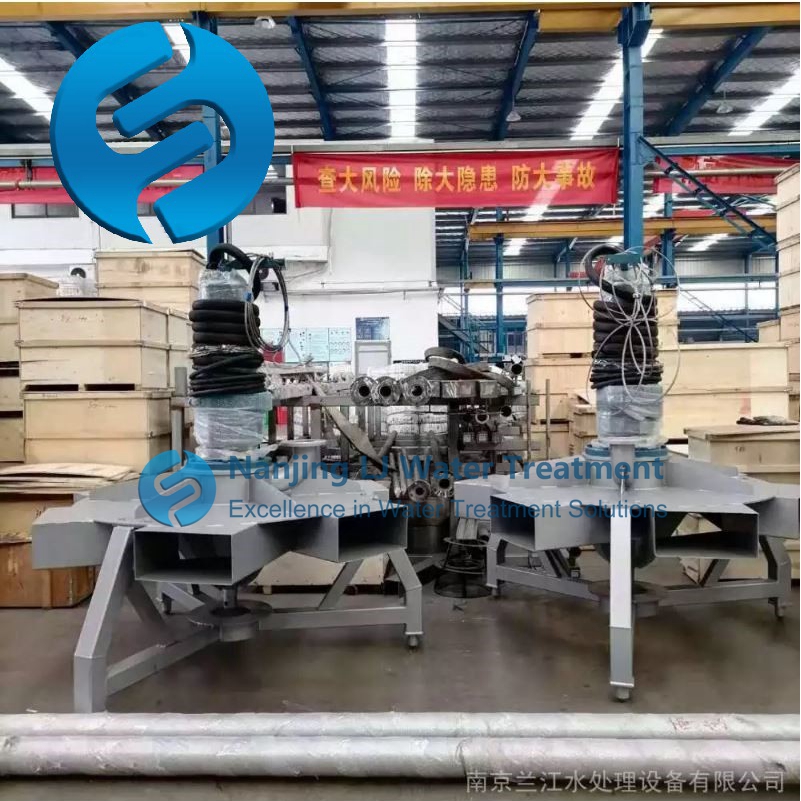
Baseline Flow Field Design for Tank-Scale Coverage
Before putting any equipment into operation, the first priority is to establish a baseline flow pattern that matches the geometric characteristics of the tank, rather than copying layouts from other sites without adaptation. The flow pusher is usually positioned to generate a continuous horizontal circulating current that sweeps across the tank bottom, carrying settled sludge and mixed liquid toward the active working zone of the aeration mixer. This arrangement ensures that no area of the tank stays in a static state for too long, which is critical for avoiding the formation of anaerobic dead zones.
The aeration mixer, in turn, creates a strong vertical lifting flow that draws water from the lower layer and mixes it with fine bubbles before releasing it upward. The two flow directions should not collide directly at high speed, because this would dissipate most of the kinetic energy and create local turbulence that wastes power. Instead, the horizontal flow from the pusher should gently feed the mixed liquid into the suction side of the aeration mixer, so that the two systems can reinforce each other rather than cancel each other out. For deep tanks with a water depth greater than 4 meters, arranging multiple layers of flow pushers at different elevations can help maintain consistent flow velocity across the entire vertical profile, preventing stratification that traps low-oxygen water at the bottom.
Operating Mode Synchronization for Variable Load Conditions
Stable combined performance cannot rely on a single fixed speed setting, because real water treatment conditions change constantly with influent load, water temperature, and sludge concentration. One of the most effective synchronization strategies is to link the operation cycle of the flow pusher with the aeration intensity of the mixer, so that the horizontal transport capacity matches the vertical mixing demand at every moment. During periods of high organic load, when the aeration mixer needs to deliver more oxygen to support intensified nitrification, the flow pusher can be set to run at a slightly higher speed to spread the oxygen-rich mixed liquid to distant areas more quickly.
Pulse staggered operation is another practical technique that reduces peak power demand while maintaining mixing stability. In this mode, the flow pusher runs for a short period before the aeration mixer starts its main aeration phase, pre-moving the settled sludge into suspension so that the subsequent aeration process can mix it evenly with dissolved oxygen immediately. When the influent load drops significantly during late night hours, the system can switch to an intermittent rotation scheme where different pusher and mixer groups take turns running. This method keeps the entire tank in a slowly circulating state without consuming the same amount of energy required for full-load continuous operation. Operators can track dissolved oxygen readings from multiple distributed sensors to fine-tune the phase difference between the two systems, ensuring that oxygen never accumulates excessively in one area while remaining insufficient in another.
Performance Calibration and Long-Term Operational Stability
Even with an excellent initial design, the flow field will gradually deviate from the ideal state after months or years of continuous operation, due to minor impeller wear, biofilm attachment, and subtle changes in water quality. Regular performance calibration should focus on verifying the actual interaction between the two systems, rather than only checking individual equipment parameters. A simple but effective field test is to release a small amount of non-toxic tracer dye near the outlet of the flow pusher, then observe how long it takes for the dye to spread evenly across the entire tank and how it interacts with the bubble flow generated by the aeration mixer. If the dye gets stuck in a certain corner or moves much slower than the designed baseline, it indicates that the current speed ratio or angle setting no longer matches the actual tank conditions.
Routine inspection should cover both systems at the same time, not separately. When the flow pusher impeller accumulates winding debris, its actual pushing distance will decrease, which means the aeration mixer will no longer receive the steady incoming flow it was originally designed for. Even if the aeration mixer itself is working perfectly, the overall mixing effect will still decline. After each underwater maintenance or component replacement, operators should run a short full-system test and adjust the relative angle between the pusher and the mixer slightly to restore the original coordinated flow path. This kind of regular fine-tuning helps maintain consistent combined performance over a long service life, avoiding the gradual energy waste and processing instability that many systems experience after extended operation.
Post time:2026-09-20
