Proper coordination between aeration mixers and aeration discs directly determines the long-term performance of water treatment systems, and many operators overlook small operational details that lead to uneven oxygen distribution, unnecessary energy waste, and shortened equipment service life. When these two sets of components work in harmony, they can create a stable water flow environment that keeps microbubbles suspended longer, improves the contact area between oxygen and pollutants, and supports more consistent microbial activity across the entire tank.
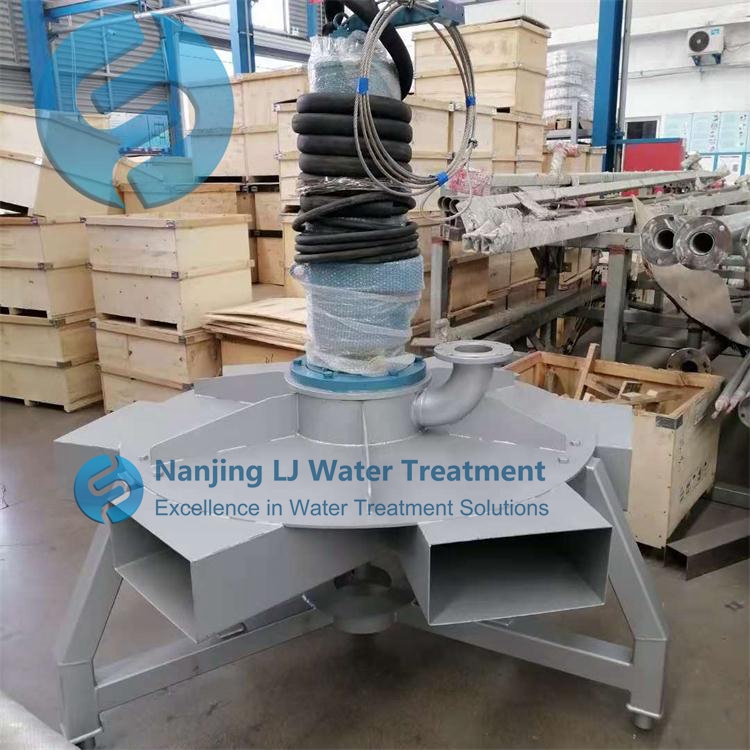
Installation Layout Optimization for Synergistic Flow Field
The first step to achieve stable cooperation is to arrange the two types of equipment in a way that avoids direct flow interference. The core working zone of the aeration disc, where microbubbles are continuously released, should not fall directly into the high-speed rotation path of the mixer impeller. If the impeller cuts through dense bubble clusters constantly, bubbles will break into larger fragments and rise to the surface too quickly, leaving little time for oxygen to dissolve into the water.
A safe horizontal distance between the mixer and nearby aeration disc groups should be maintained, so that the water flow pushed by the mixer can spread bubbles gently instead of tearing them apart. In vertical arrangement, the impeller should be placed either 0.5 to 1 meter above or below the main aeration layer, so that the circulating flow can carry bubbles to every corner of the tank without disrupting their initial formation state. For circular tanks, placing the mixer near the center and arranging aeration discs along the inner wall can form a continuous upward and downward circulation that prevents dead zones where sludge settles without receiving sufficient oxygen. For square tanks, staggered placement of multiple mixers and aeration disc groups can cover the sharp corners that regular layouts often miss.
Parameter Matching and Dynamic Adjustment During Operation
Even with a reasonable static layout, uncoated operating parameters can still reduce the overall system performance. The first key parameter to adjust is the mixer rotation speed, which should be set according to the actual aeration volume instead of running at a fixed value all the time. If the rotation speed is too high under low aeration volume, the strong shear force will crush most fine bubbles and make them escape from the water surface in a very short time. If the rotation speed is too low under high aeration volume, bubbles will gather in a small area and cannot spread evenly to distant areas of the tank.
Pulsed air supply sequencing can also be introduced to further improve the matching effect. A typical working cycle can be set to 2 to 3 seconds of air supply followed by 7 to 20 seconds of pause, which helps eliminate large air pockets that form inside the pipe network and reduces the chance of short-circuit flow. When the dissolved oxygen sensor in a certain area of the tank detects a value lower than the preset threshold, the system can slightly increase both the aeration volume of nearby disc groups and the corresponding mixer speed, so that the oxygen can be quickly transported to the low-oxygen area without wasting extra energy on already saturated zones. This dynamic adjustment method avoids the common mistake of running all equipment at full load regardless of actual water quality changes.
Synchronized Maintenance and Long-Term Performance Stabilization
Many performance drops in cooperative operation come from asynchronous maintenance schedules, where one set of components develops a hidden fault and the other continues to work as usual, breaking the original balanced flow field. When the mixer impeller accumulates winding debris or attached sludge, its actual pushing efficiency will decrease significantly, and the water flow it generates will no longer be strong enough to spread bubbles to the designed coverage area. At this time, even if the aeration discs are in perfect condition, local low dissolved oxygen areas will still appear.
Regular underwater inspection should check both the mixer surface and the aeration disc diaphragm at the same time. When the transmembrane pressure of the aeration disc increases by 15% or the standard oxygen transfer efficiency drops by 20%, corresponding cleaning work should be carried out, and the mixer impeller should also be inspected for wear and attachment during the same maintenance window. After each maintenance, a short-term full-flow test should be conducted to observe the bubble distribution state across the entire tank, and minor adjustments can be made to the mixer angle or local aeration disc air volume to restore the original uniform flow field. This synchronized inspection habit can prevent small faults from developing into large performance deviations, and keep the cooperative efficiency of the two systems at a high level for years of continuous operation.
Post time:2026-09-20
