Water Disturbance Principle of Push-Flow Aeration Mixers
Push-flow aeration mixers are widely used in oxidation ditches, wastewater treatment tanks, aquaculture systems, and industrial water circulation projects. Their operating principle focuses on generating directional water movement while simultaneously improving oxygen transfer within the liquid. Through continuous propulsion and controlled turbulence, these systems help maintain dissolved oxygen balance, prevent sediment accumulation, and support stable biological treatment conditions.
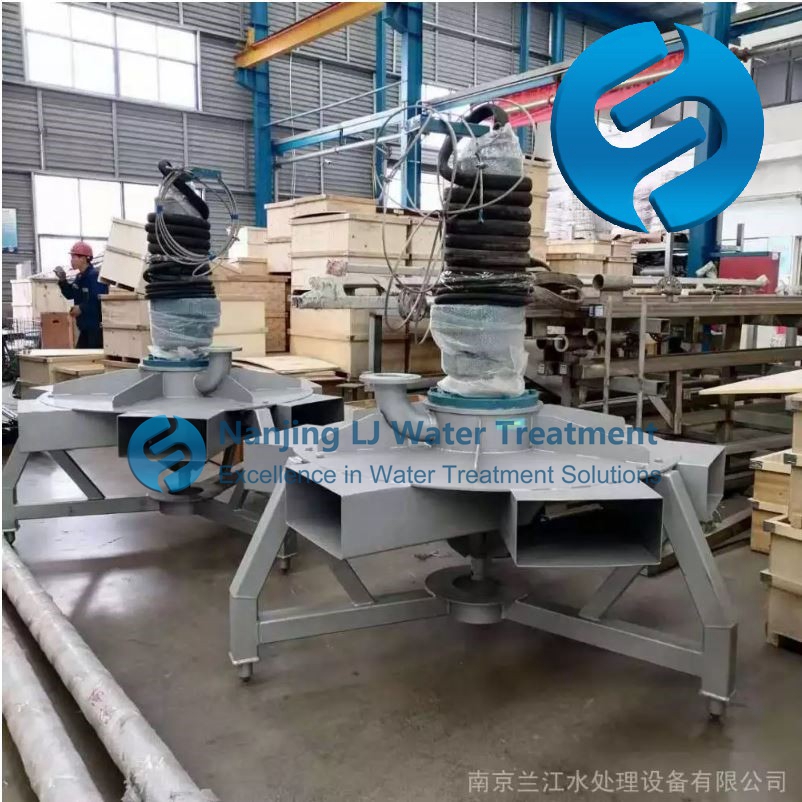
Basic Push-Flow Disturbance Mechanism
The core function of a push-flow aeration mixer is to create continuous directional water movement.
Directional Water Propulsion
The rotating impeller generates forward thrust that pushes large volumes of water through the treatment basin. This directional flow creates a stable circulation path inside the system.
Continuous Liquid Disturbance
As water moves through the tank, the flowing current disturbs surrounding liquid layers and prevents stagnant conditions from forming.
Combined Aeration and Circulation
Air enters the liquid stream during propulsion, allowing oxygen transfer and water mixing to occur simultaneously throughout the circulation process.
Impeller-Driven Water Movement
The impeller plays a central role in generating hydraulic disturbance.
High-Speed Rotational Force
The impeller blades rotate rapidly and convert mechanical energy into hydraulic energy, producing strong liquid movement within the treatment area.
Formation of Axial Flow
Unlike purely swirling systems, push-flow aeration mixers mainly generate axial water movement in a consistent forward direction.
Expansion of Flow Coverage
The propulsion effect allows water circulation to extend across larger treatment zones, improving oxygen distribution throughout the tank.
Turbulence Generation Principle
Controlled turbulence improves both mixing efficiency and oxygen transfer.
Interaction Between Water Layers
As the propelled liquid moves forward, it interacts with surrounding stationary water, generating turbulence within the flow field.
Reduction of Dead Zones
Continuous disturbance helps maintain circulation in corners and low-flow regions where oxygen depletion might otherwise occur.
Prevention of Sediment Deposition
Strong water movement keeps suspended solids active within the liquid, reducing sludge accumulation at the tank bottom.
Oxygen Transfer Through Water Disturbance
Water disturbance directly affects aeration performance.
Bubble Dispersion in Flowing Water
Air bubbles entering the liquid stream are distributed throughout the moving water by turbulent flow action.
Increased Gas-Liquid Contact
The disturbed flow continuously renews the contact area between oxygen bubbles and surrounding liquid, improving oxygen dissolution efficiency.
Uniform Dissolved Oxygen Distribution
Directional circulation helps oxygen spread evenly throughout the treatment basin, supporting stable biological activity.
Hydraulic Characteristics of Push-Flow Systems
Push-flow aeration mixers create distinct hydraulic flow patterns.
Long-Distance Water Circulation
The directional thrust allows liquid to travel across extended sections of the treatment system before returning through natural circulation paths.
Stable Flow Velocity
Consistent propulsion maintains continuous liquid movement without excessive hydraulic fluctuation.
Balanced Pressure Distribution
The controlled flow structure helps distribute hydraulic force evenly throughout the treatment basin.
Biological Treatment Support Mechanism
Water disturbance contributes to improved biological treatment conditions.
Enhanced Oxygen Supply for Microorganisms
Continuous oxygen circulation supports aerobic microorganisms responsible for organic matter decomposition.
Improved Nutrient Mixing
Directional water movement distributes nutrients and biological material more evenly throughout the treatment environment.
Stable Biological Reaction Conditions
Consistent flow and oxygen levels help maintain favorable conditions for biological treatment efficiency.
Structural Influence on Water Disturbance
Equipment design directly affects the disturbance pattern created during operation.
Impeller Blade Geometry
Blade angle and structural design determine the strength and direction of the push-flow circulation pattern.
Aeration Outlet Configuration
Air diffusion structures are arranged to maximize oxygen transfer within the moving water stream.
Streamlined Flow Channel Design
Internal hydraulic pathways help guide water movement efficiently while minimizing unnecessary resistance.
Operational Advantages of Push-Flow Disturbance
The push-flow principle provides several practical operating benefits.
Suitable for Large Oxidation Ditches
Directional circulation is highly effective in elongated treatment channels where continuous flow movement is required.
Adaptability to Variable Water Conditions
Push-flow systems can maintain stable circulation even when sludge concentration or hydraulic load changes.
Improved Water Quality Stability
Continuous disturbance reduces localized oxygen depletion and helps maintain more uniform treatment conditions throughout the system.
Environmental and Circulation Benefits
Push-flow disturbance can also improve environmental performance in water treatment applications.
Reduced Surface Scum Formation
Continuous water movement helps prevent floating sludge and surface film accumulation.
Enhanced Overall Water Renewal
The circulation pattern supports constant exchange between upper and lower liquid layers, improving water quality consistency.
Support for Ecological Water Systems
Stable oxygen circulation and water movement contribute to healthier aquatic environments in ecological restoration and aquaculture projects.
Post time:2026-05-28
