How to Choose the Right Impeller Size for 2900mm Dosing Tanks with Solid Particles?
When designing a
Recently, we worked with a client from Africa who required a mixing solution for a large dosing tank. The project presented unique challenges that required a professional recalibration of their original specifications.
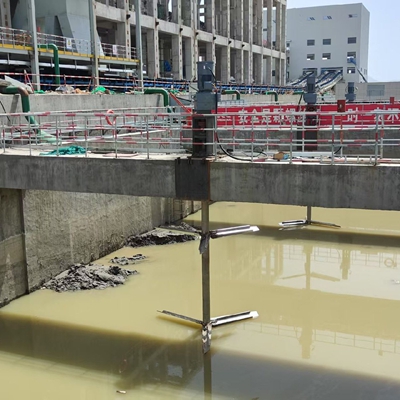
The Case Study: Mixing 5mm Solid Particles
The client’s project involved a dosing tank with the following dimensions:
Tank Diameter (T): 2900mm
Tank Depth: 2200 mm
Medium: Liquid containing approximately 5 mm solid particles.
Material Requirement: All wetted parts in AISI 316L stainless steel.
Initially, the client requested a 600 mmdiameter impeller (double-layer, 3-blade type) powered by a 3.7 kW motor with a 60 mm shaft.
Why a 600mm Impeller Was Not Enough
In mixing technology, the D/T Ratio is the ratio between the Impeller Diameter and the Tank Diameter :
D/T = Impeller Diamete/Tank Diameter
For applications involving solid suspension (keeping particles from settling at the bottom), the industry standard D/T ratio usually falls between 0.25 and 0.45.
The client's original 600mm proposal resulted in a ratio of:
600 / 2900≈ 0.20
A ratio of 0.20 is at the absolute critical minimum. For 5 mm solid particles, this small "footprint" would likely result in "dead zones" near the tank walls, leading to particle buildup and inconsistent dosing.
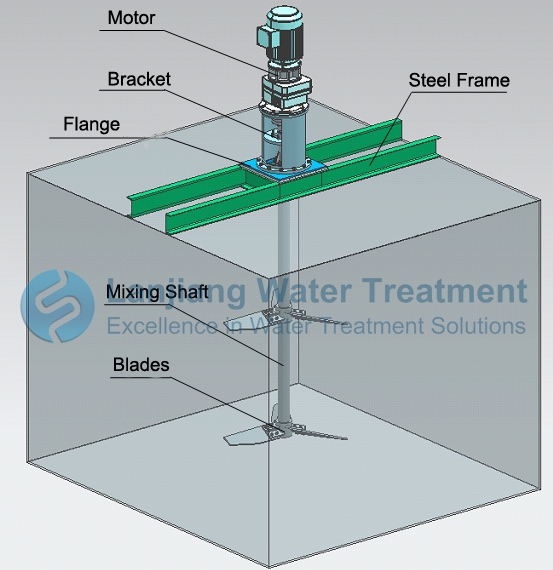
Our Engineered Solution: Optimizing for Performance
To ensure the solids remain fully suspended and to prevent equipment fatigue, our engineering team suggested a more robust configuration:
1. Increasing the Impeller Diameter
We recommended upgrading to an 800 mm diameter impeller. This brings the D/T ratio to 0.27, safely within the optimal range for solid suspension.
2. Upgrading Power and Stability
Increasing the blade size increases the torque and resistance. Therefore, we adjusted the mechanical specs to ensure durability:
Motor Power: Upgraded from3.7 kW to 4 kW.
Shaft Diameter: Increased from 60 mm to 76 mm to handle the higher bending moments.
Output Speed: Optimized at 130 rpm.
The Result
By choosing a larger
At
Post time:2026-03-10
