Anti-Corrosion Aeration Mixer Surface Treatment: What Actually Protects the Metal
Exposed to wastewater, industrial effluent, or brackish water every single day, an aeration mixer does not get a break. Chloride ions, hydrogen sulfide, fluctuating pH, and microbial activity all attack the metal surface simultaneously. Without proper surface treatment, even stainless steel will pit within months. The right coating or finishing process is not a cosmetic choice — it is the difference between a mixer that lasts five years and one that fails in eighteen months.
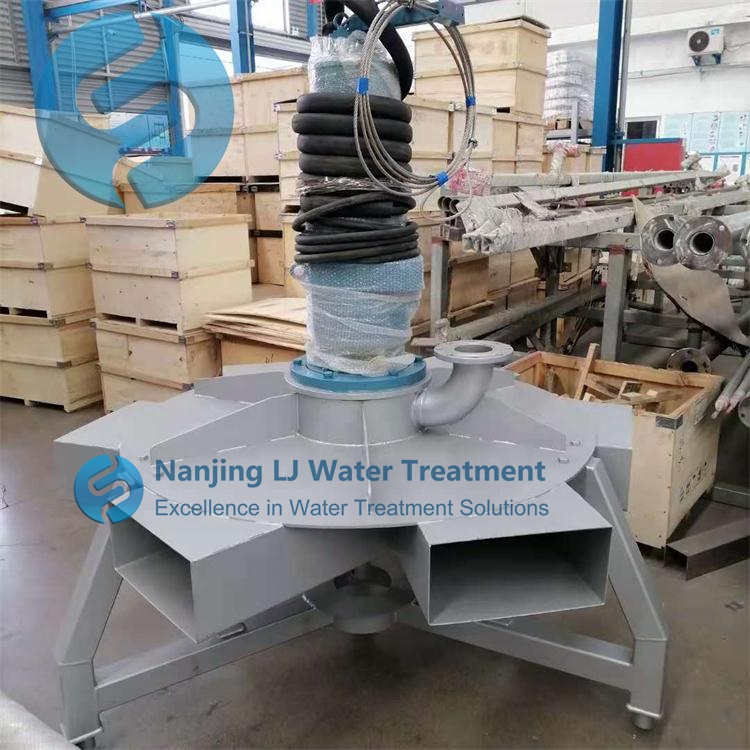
Surface treatment for anti-corrosion aeration mixers goes far beyond painting the outside. It involves substrate preparation, primer selection, topcoat chemistry, and sometimes entirely different metallurgical approaches. Getting any one of these wrong means the coating peels, blisters, or corrodes from underneath.
Why Corrosion Hits Aeration Mixers So Hard
Most people assume corrosion is a slow, uniform process. In reality, aeration mixers face a perfect storm of aggressive conditions that accelerate material loss in very specific ways.
The Oxygen-Rich Paradox
Aeration mixers pump oxygen into water — but that same oxygen is what eats the metal. Dissolved oxygen concentrations in aeration basins typically run between 2 and 8 mg/L, and in some industrial applications they go much higher. Oxygen fuels the electrochemical reaction that drives rust and pitting. The very function of the mixer creates the environment that destroys it.
Add to that the constant mechanical stress from rotation. Every vibration cycle opens micro-cracks in the protective layer. Those cracks let water and ions reach the bare metal underneath. Once a pit starts, it grows faster than any coating can self-heal.
Chemical Attack Varies by Water Type
Wastewater is not one thing. Municipal sewage carries moderate chloride levels — usually 50 to 200 ppm. Industrial effluent can push past 5,000 ppm. Seawater sits around 19,000 ppm chloride. Hydrogen sulfide from anaerobic zones attacks metal through a completely different mechanism — sulfide stress cracking — which no amount of paint can stop if the base material is wrong.
This means surface treatment must be matched to the specific water chemistry. A coating that works perfectly in a municipal plant will fail catastrophically in a paper mill or a coastal desalination facility.
Surface Preparation: The Step Everyone Skips
The coating is only as good as the surface it sits on. Industry data consistently shows that 60 to 80 percent of coating failures trace back to poor surface preparation, not bad paint. For aeration mixers, this step is non-negotiable.
Blasting and Cleaning Standards
Steel surfaces must be blasted to at least SSPC-SP6 (commercial blast) or ideally SSPC-SP10 (near-white metal blast). This removes mill scale, rust, welding slag, and any organic residue. The surface profile needs to be between 1.5 and 3.0 mils (40 to 75 micrometers) — enough texture for the primer to bond mechanically, but not so rough that it creates stress concentration points.
For mixers already in service, the challenge is different. You cannot always blast every surface. In those cases, power tool cleaning to St 3 grade is the minimum acceptable standard. Any remaining rust must be treated with a conversion coating before primer application.
The Role of Phosphating and Conversion Coatings
On carbon steel substrates, a zinc phosphate or iron phosphate conversion coating serves as a bridge between bare metal and primer. It provides a crystalline layer that improves adhesion and adds a thin sacrificial barrier. This step is often skipped on stainless steel substrates — and that is a mistake. Even stainless steel benefits from a light etch or passivation treatment before coating to ensure the topcoat adheres properly.
Coating Systems That Actually Work Underwater
Not all paints survive submersion. Not all survive rotation. The coating system for an anti-corrosion aeration mixer must handle hydrostatic pressure, UV exposure (for parts above water), abrasion from suspended solids, and constant thermal cycling.
Epoxy-Based Systems for Full Submersion
For mixers that stay fully submerged, epoxy coatings are the workhorse. Novolac epoxy primers offer superior chemical resistance compared to standard bisphenol-A epoxy. They handle high chloride environments and resist osmotic blistering — a common failure mode where water pushes through the coating and lifts it off the metal in bubble-like formations.
The topcoat in a full submersion system is often a high-build epoxy or a polyurethane-epoxy hybrid. These provide abrasion resistance against sand, grit, and debris that constantly hits the impeller and shaft. Typical dry film thickness runs 400 to 600 micrometers total — primer plus topcoat. Thinner than that, and you get pinholing. Thicker, and the coating becomes brittle and prone to cracking under vibration.
Polyurethane and Fluoropolymer Options for Splash Zones
The splash zone — where the mixer shaft meets the water surface — is the most corrosive area on the entire unit. It gets hit by oxygen-rich water, UV radiation, and wet-dry cycling all at once. Standard epoxy degrades quickly here.
Polyurethane topcoats handle UV far better than epoxy. Fluoropolymer finishes (PVDF or FEVE) go even further — they resist chemical attack, UV degradation, and fouling simultaneously. These are expensive, but for mixers in aggressive splash zones, they pay for themselves in reduced maintenance.
Zinc-Rich Primers and Cathodic Protection Integration
On carbon steel mixers, zinc-rich epoxy primers serve double duty. They provide barrier protection and act as a sacrificial anode — corroding preferentially to protect the underlying steel. This is especially valuable in areas where the coating gets nicked or scratched during installation.
