The principle of water quality homogenization using an aeration mixer centers on overcoming the natural tendency of liquids in a tank to stratify and form concentration gradients. It is a proactive engineering process that applies controlled fluid dynamics to create a uniform mixture, ensuring every unit volume of water has nearly identical chemical and physical characteristics before it proceeds to the next treatment stage.
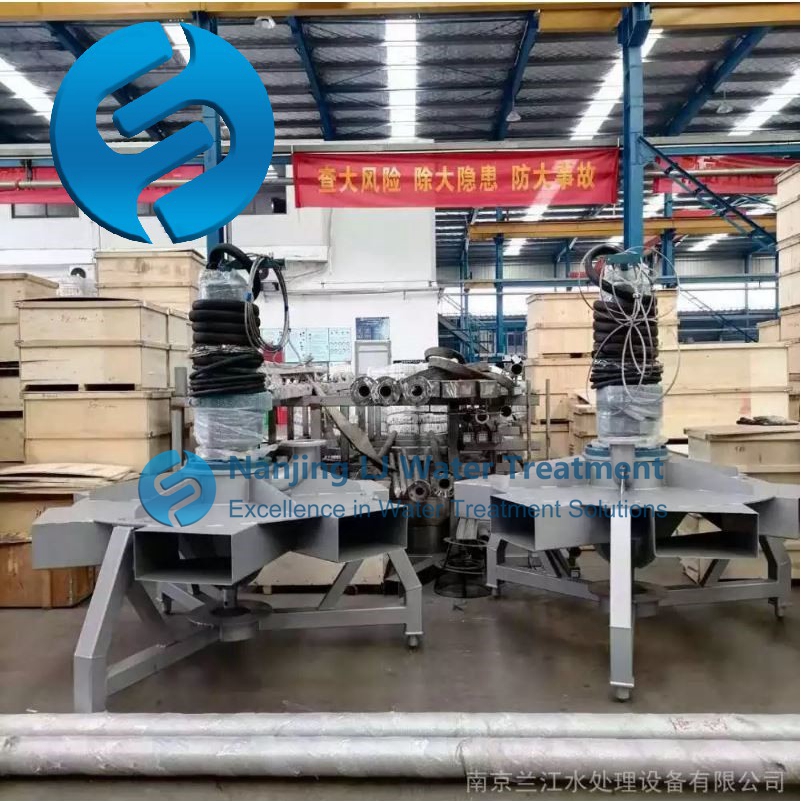
Disrupting Density and Concentration Gradients Through Forced Convection
The foundational action of the mixer is to replace the slow process of molecular diffusion with rapid, forced convection. In a static tank, differences in temperature, salinity, or chemical concentration create layers of varying density.
The impeller generates a dominant flow current, typically a axial or radial pattern, which imposes a predictable circulation path on the entire tank volume. This current actively pulls fluid from areas of high concentration or different density and transports it across the tank, physically blending it with fluid from other zones. For instance, in a tank receiving high-strength industrial discharge, the mixer prevents the incoming dense stream from flowing along the bottom as a separate "river." Instead, it immediately entrains this stream into the bulk flow, tearing it apart and dispersing its constituents. This mechanical blending happens on a macroscopic scale, thousands of times faster than diffusion, effectively erasing sharp boundaries and creating a single, homogeneous body of water with minimized local variations.
Achieving Micro-Scale Uniformity for Consistent Process Feed
Beyond macro-scale blending, effective homogenization requires achieving uniformity at the micro-scale, ensuring that reactive chemicals or microorganisms encounter consistent conditions throughout the tank.
This is where the interplay between mixing intensity and tank geometry is critical. The energy input from the mixer must be sufficient to generate enough fluid shear to break down clusters of particles or droplets (like fats or chemical flocs) and to prevent the reformation of local micro-environments. The goal is to create a state where a sample taken from any location—top, bottom, center, or near the walls—has the same pH, temperature, chemical concentration, and suspended solids profile. This micro-scale uniformity is essential for downstream processes. It means that a pH probe or a chemical dosing pump reading from one point can reliably control the entire tank's condition. It ensures that when this water is fed to a biological reactor, the microorganisms receive a steady, predictable diet, not a series of feasts and famines that lead to process upsets.
Integrating Aeration for Chemical and Biological Stabilization
While mixing provides the mechanical energy for blending, the simultaneous introduction of air serves multiple stabilizing functions that are integral to the homogenization principle.
The rising column of microbubbles creates additional vertical lift and turbulence, assisting the impeller in breaking up stratified layers. More importantly, the introduced oxygen acts as a chemical homogenizing agent. In wastewater holding tanks, localized anaerobic conditions can quickly develop in stagnant corners, leading to acid production, odor generation (like hydrogen sulfide), and the reduction of compounds like sulfates. The aeration function ensures that dissolved oxygen is distributed throughout the tank, suppressing these undesirable anaerobic reactions and maintaining a uniform redox potential. This creates a chemically stable environment where the composition of the water does not change unpredictably during the holding period. The water delivered from the tank is not only physically mixed but also chemically conditioned, having a consistent dissolved oxygen level and oxidation state that prepares it for subsequent treatment steps.
Post time:2026-07-02
