When evaluating aeration mixer performance, the impeller’s agitation efficiency parameters provide the clearest window into how effectively the system converts rotational energy into useful water movement and gas dispersion. Many operators focus only on total power draw or oxygen transfer numbers, missing the critical link between impeller design and the actual fluid dynamics that determine long-term system success. These parameters measure the impeller’s ability to create stable, controlled flow patterns that maximize bubble-water contact time while minimizing energy wasted on unnecessary turbulence or surface splashing.
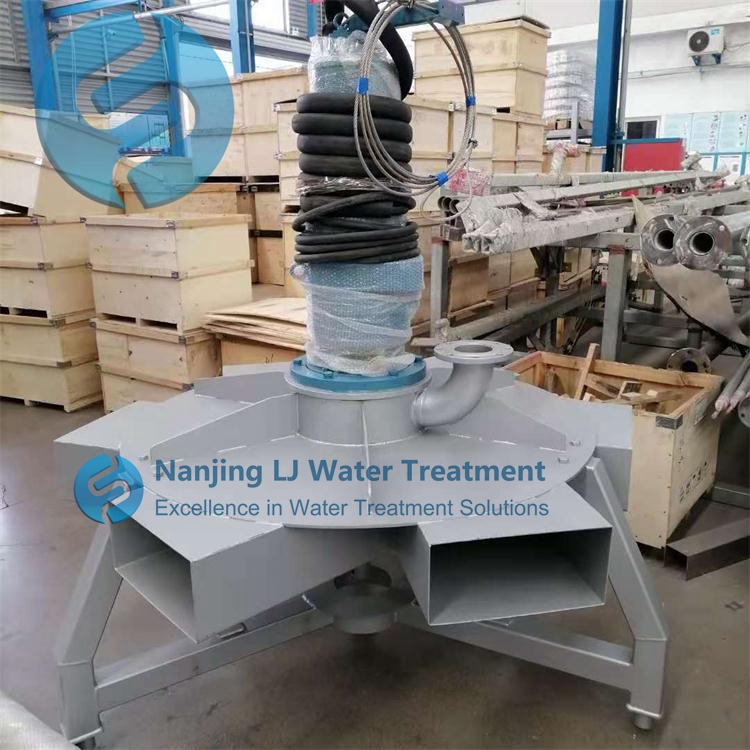
Hydraulic shear intensity and bubble size distribution control
This parameter defines the impeller’s ability to generate the precise level of hydraulic shear needed to break incoming gas streams into optimal bubble sizes for the specific water conditions. Too little shear creates large, fast-rising bubbles that escape to the surface before transferring much oxygen, while excessive shear produces ultra-fine bubbles that stay suspended too long and can cause foam or over-saturation issues. The efficiency benchmark here requires that the impeller maintain a consistent bubble size distribution across a wide range of operating speeds and gas flow rates, adapting automatically to changes in water viscosity or solids content. This is especially important in wastewater applications, where varying organic loads can change the fluid characteristics hour by hour, requiring an impeller that delivers stable performance without constant manual adjustment.
Axial and radial flow balance for full-volume mixing
Aeration impellers must generate both strong axial flow to draw water from the surface down to the bottom, and sufficient radial flow to spread that mixed water horizontally across the entire basin. This parameter measures the ratio between these two flow components, ensuring that neither one dominates to the point of creating dead zones or excessive sediment resuspension. An optimal balance pushes oxygen-rich surface water down to the benthic layer where it is needed most, while also creating enough horizontal movement to carry dissolved oxygen to the farthest corners of the basin. Systems that excel in this parameter show minimal vertical stratification and consistent dissolved oxygen readings at all sampling points, proving that the impeller is creating true full-volume circulation rather than just local agitation near the unit itself.
Energy transfer efficiency and power consumption per unit flow
This final parameter quantifies how much of the motor’s input power actually converts into useful water movement, rather than being lost to mechanical friction, heat generation, or inefficient flow patterns. The benchmark here is measured in flow volume per kilowatt-hour, providing a direct comparison between different impeller designs under identical operating conditions. High-efficiency impellers move more water with less power by using advanced blade geometries that reduce drag and minimize vortex shedding, which steals energy without contributing to useful mixing. This parameter becomes especially critical in continuous 24/7 operations, where even small improvements in energy transfer efficiency can translate into significant long-term power savings without any reduction in treatment performance.
Even two impellers with identical diameter and rotation speed can produce dramatically different mixing results based on these three efficiency parameters. Mapping flow patterns and measuring power draw under real operating conditions will show you exactly how much useful work your current impeller is delivering, and where potential improvements might be hiding.
Post time:2026-08-05
