In sludge holding tanks and thickening units for wastewater treatment systems, uncontrolled sludge sedimentation is one of the most common and troublesome operational issues that can trigger a chain of secondary problems for the whole sludge treatment workflow. The targeted aeration mixing approach for these units focuses on maintaining a consistent, low-energy flow state that keeps all sludge particles in uniform suspension, without creating unnecessary turbulence that disrupts the natural thickening process.
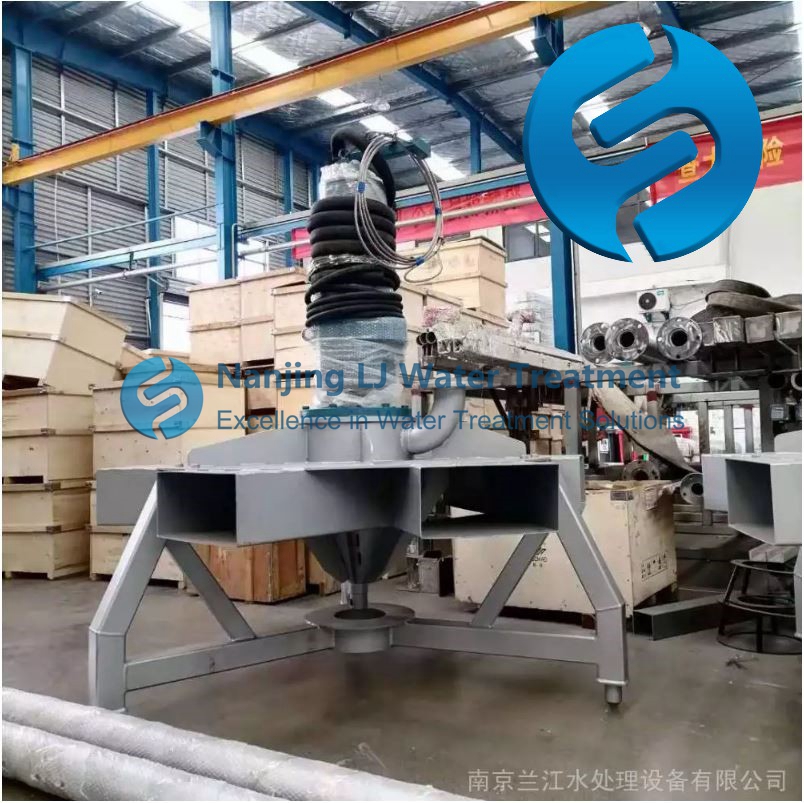
Maintaining Uniform Sludge Concentration Across Full Tank Volume
The core working logic of anti-sedimentation operation in sludge tanks is to eliminate the uneven distribution of sludge solids that often happens in static or poorly mixed storage units.
When excess activated sludge or mixed thickened sludge is pumped into the tank from the secondary clarifier, the gentle circulating flow spreads the high-concentration sludge evenly across every section of the tank, instead of letting heavy sludge particles sink immediately near the inlet and form a dense compact layer that blocks the outlet pipeline. This uniform concentration state ensures that the sludge pumped out to the subsequent dewatering units always carries a consistent solids content, so the dewatering equipment can run at a stable working parameter without frequent adjustments caused by sudden changes of sludge density. Without this sustained even mixing, large areas of the tank would end up holding clear supernatant water with almost no solids, while the bottom corners accumulate sludge with a solids concentration far higher than the designed range, making the whole sludge storage process completely unmanageable.
Preventing Anaerobic Fermentation of Settled Sludge Layers
Proper anti-sedimentation mixing stops thick static sludge deposits from staying undisturbed for long periods, which is the main trigger for odor release and sludge quality degradation in closed sludge tanks.
When a layer of settled sludge sits undisturbed on the tank floor for more than a few hours, it quickly uses up all residual dissolved oxygen and turns completely anaerobic, triggering the growth of bacteria that produce hydrogen sulfide, methane and other foul-smelling metabolic byproducts. The mild continuous movement generated by the mixing action keeps the entire sludge mass in a flowing state, so no large volume of sludge can stay in a completely static anaerobic environment long enough to start the fermentation process. The small amount of fine air bubbles introduced during the aeration process also maintains a micro-aerobic environment inside the mixed sludge, preventing the sludge from turning black and producing corrosive gases that would damage the tank structure and connected sludge transfer pipelines, while also reducing the unpleasant odor that often leaks out from poorly maintained sludge storage units.
Avoiding Sludge Stratification and Floating Scum Buildup
Well-calibrated anti-sedimentation operation in sludge tanks eliminates the layered structure that forms when different types of sludge particles separate by density under static conditions.
Light, buoyant sludge flocs that carry trapped gas bubbles tend to float to the top of the tank and form a thick, hard crust of scum when there is no mixing force to disrupt them, and this crust can block the normal exhaust vents of the tank and create unexpected pressure buildup risks. The slow, steady vertical flow generated by the mixing action breaks this surface scum layer apart continuously, mixing the light floating flocs back into the bulk sludge mass so they stay in uniform suspension with the rest of the solids. This controlled flow state also prevents heavy inorganic grit particles from settling and forming a hard compact layer at the very bottom of the tank, which would otherwise solidify over time and become impossible to remove even with high-pressure flushing, permanently reducing the effective working volume of the sludge tank.
Post time:2026-07-03
