When designing the supporting air supply layout for aeration mixers, the matching logic must follow the actual flow field demand of the water body rather than a fixed set of standard parameters. A well-coordinated air supply system can maximize the oxygen dissolution effect while reducing unnecessary energy consumption during long-term operation.
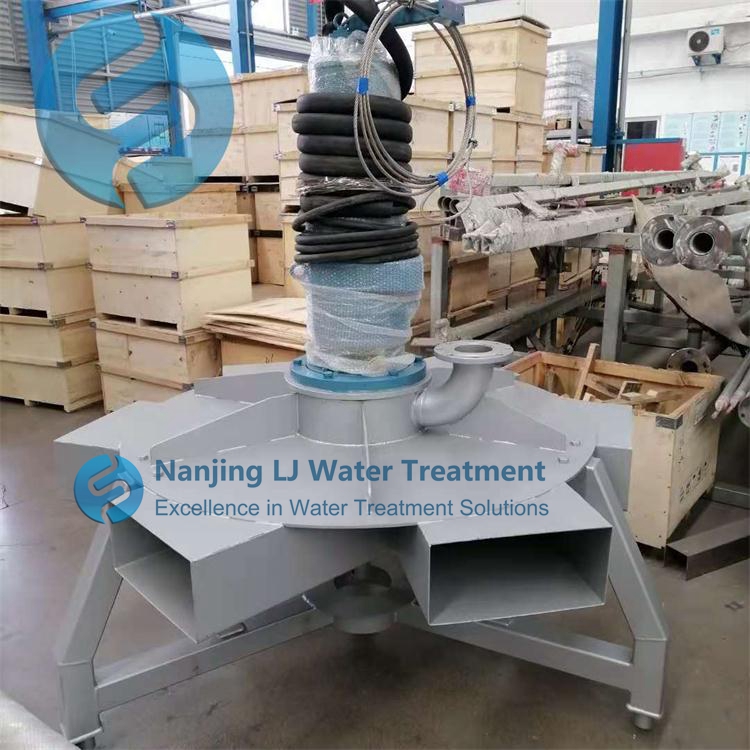
Air Supply Demand Mapping Based on Working Condition Scenarios
Before determining any specific matching mode, you need to sort out the core operation goals of the aeration mixer in different periods, so that the air supply output can be accurately aligned with the actual demand.
Aeration Priority Operation Scenarios
When the system focuses on increasing dissolved oxygen concentration, the air supply side needs to provide stable and continuous airflow that matches the oxygen transfer demand. The air output should be adjusted dynamically according to the real-time dissolved oxygen value in the water, rather than maintaining a fixed high flow rate all the time. In this scenario, the air supply system needs to respond quickly to the load change, ensuring that the fine bubbles generated by the aeration mixer can get sufficient residence time in the water body.
Mixing Priority Operation Scenarios
When the system only needs to drive water circulation without additional oxygen supplement, the air supply can be completely cut off or reduced to an extremely low level. At this time, the aeration mixer mainly relies on mechanical thrust to push the water flow to realize full tank mixing, and the air supply equipment only needs to maintain standby state. This matching mode can effectively reduce unnecessary energy consumption, and avoid excessive air input leading to turbulent flow that damages the stability of the water body environment.
Pipeline Layout and Pressure Balance Design
The connection mode between the air supply equipment and the aeration mixer directly affects the consistency of air output at each layout point, and unreasonable layout will lead to obvious deviation of aeration effect in different areas.
Resistance Loss Control
The total pressure provided by the air supply side must be higher than the sum of water depth pressure, pipeline transmission resistance and a certain safety margin. Too low pressure will lead to insufficient air output of the aeration mixer far away from the air source, and too high pressure will cause unnecessary energy waste. The layout of the main pipeline and branch pipelines should avoid too many sharp turns, which will effectively reduce the extra resistance generated when the air flows through the pipeline.
Multi-Point Synchronous Air Supply
When multiple aeration mixers share one set of air supply system, it is necessary to set independent flow regulation units for each branch. This way, you can fine-tune the air input of each position according to the local water quality demand, instead of making all equipment get exactly the same air volume. This matching method can adapt to the complex tank structure, and avoid the situation that the aeration effect in some areas is too strong while other areas cannot get enough air supply.
Operation Linkage and State Coordination Mechanism
The coordination between the air supply equipment and the aeration mixer is not only limited to the static parameter matching, but also needs to realize dynamic synchronization in the whole operation cycle.
Start-Stop Sequence Matching
When the system starts up, the aeration mixer should first enter the running state to form a stable internal flow field, and then the air supply equipment begins to deliver airflow. This sequence can avoid the problem that air cannot be fully sheared into fine bubbles due to insufficient thrust of the mixer, which leads to a large number of large bubbles escaping from the water surface directly. When the system stops running, the air supply equipment should stop sending air first, and the aeration mixer can continue to run for a short time to discharge the residual gas in the structure.
Load Dynamic Adjustment
In different operation stages such as clean water commissioning, formal sewage treatment and low-load maintenance, the air supply volume and the running power of the aeration mixer can be adjusted in linkage. When the water quality load is low, the air supply can be appropriately reduced and the mixing speed can be maintained, so that the system can still maintain good circulation effect. This flexible matching mode can make the whole system adapt to a wider range of working condition changes, and maintain efficient operation under different loads.
Post time:2026-09-29
